viernes, 30 de marzo de 2012

Do social interactions deliver higher value conversions than natural search?

Posted 29 March 2012 12:17pm by David Moth with 0 comments

A new study from e-Dialog and ClearSaleing suggests that conversions that occur after exposure to a brand on social media deliver more than $280 per order - compared to less than $100 for those that are driven by natural search.

Social also delivers better revenue per click ($5.24) than email ($3.18) and paid search ($4.38), indicating that purchasing intent is high.

The Guide To Market Leadership 2012 set out to identify the trends that will impact digital marketing this year, including improving conversion quality, increasing the focus on customer intent and seeking quality in display media campaigns.

Improve Conversion Quality

The report found that efforts to increase conversion rates need to focus as much on the consumer journey before they reach the site as the on-site experience.

For example, when a display advertisement was included in a conversion path the average revenue per order increased to more than $206, almost 65% more revenue than the overall average order size of $135.37.

e-Dialog says that online marketers should focus time and effort on growing channels as "the more visually and emotionally connected channels, such as display and social media, have proven to be highly effect the overall revenue per order, when present in a conversion path."

Increase focus on consumer intent

The study found that channels with traditionally high consumer intent continue to be safe bets for online spend. 

For example, paid search showed a relatively high intent factor, with an average of $4.38 revenue per click in this study. 

However the findings illustrate that in addition to the increase in revenue per order when social media is present in a conversion path, the channel also offers a higher level of intent to buy than any other channel. 

When social media was present in a click path, the social media click accounted for $5.24 in revenue, an 8% increase over the overall average, and more than 84% more revenue than from natural search.

The report clarifies that "although social media is still in its early states in terms of revenue capture, it is proving a core channel for capturing intent and driving quality customers."

Seek quality in display media campaign

e-Dialog also evaluated the strength of various display ad channels in starting new customer conversations within the overall consumer journey.

Premium publishers (those that belong to the Online Publisher Assocation) displayed twice the ability of ad networks, and four times the ability of Demand Side Platform's (DSPs) to introduce and start new customer conversations. 

This means that within online display, roughly 8.4% of all premium publisher advertising interactions were the beginning of new customer purchase paths. 

Enhance visibility and efficiency in downstream channels

The report looked at the performance of marketing channels that are often seen as downstream channels due to their strong performance on a last ad basis.

With the exception of affiliate marketing, all channels saw an increase in order credit when analysed through an attribution lens.

The report suggests that this undermines the view that moving to an attribution model may negatively impacting channels like search and email.

Additionally, as these channels tend to use performance-based pricing, data automation from the attribution platform to the appropriate bidding agents will make the efficiency gains of attribution an automated function, as opposed to a manual function." 

Conclusion

The findings of this report will make good reading for the likes of Twitter and Facebook, which have been making efforts recently to promote the power of social as a marketing tool.

Social certainly appears to be a key indicator for purchase intent, but it is still unclear whether social can be said to drive sales or is simply the channel that consumers use to engage with brands they are already 'fans' of.

What is apparent is that working out an attribution programme is a useful tool for brands when making decisions about marketing budgets.

The data in this report came from advertisers using ClearSaleing's platform, including retail, luxury retail, travel, healthcare, education and financial services, between January 1st 2010 and August 31st 2011. 

This included more than 56bn impressions, 2.7bn clicks and $13bn (£8.3bn) in revenue.

David Moth is a Reporter at Econsultancy. You can follow him on Twitter. 

Digital marketing to Hispanics in the US

Posted 29 March 2012 17:16pm by Lorena Leonard with 0 comments

The 2010 US Census reported over 50 million Hispanics living in the US, accounting for 15.2 million of the total US population growth.

With the explosive growth of the US Hispanic population, it is baffling to see that many businesses are still not marketing directly to this segment. This may be due to a lack of understanding about the audience and why marketing to them directly makes sense. Also, there is the question of where to find them and how to reach them.

Traditional media has worked well for marketing to Hispanics, but the shift to the digital sphere has also seen changes in Hispanic media consumption. For starters, there are currently over 32 million US Hispanics online; and this number is expected to reach 42 million within the next 3 years. This is a big number but what does it really mean in terms of marketing?

Let's take a closer look at this number in comparison to the US general market. Overall, Hispanics are spending more time and are interacting more online than other ethic groups, including Whites. The Association of Hispanic Advertising Agencies (AHAA) compiled the following research findings from various sources. Here's how that number breaks down:

  •  US Hispanics spend 10 minutes more daily on social networks, an average of 29 minutes per day, than non-Hispanic Whites.
  • With regards to content creation, 40% of US Hispanics publish blogs and websites, create and upload videos, and post articles and stories they've written compared to only 12% of non-Hispanics. 
  • US Hispanics are also digital critics. Thirty-nine percent of Hispanics post ratings and reviews of products they've purchased and services they've received. They also comment on blogs and websites, while only 15% of non-Hispanics participate in these activities. 
  • US Hispanics are just as social online. Forty percent of them visit social networks and maintain profiles in these networks compared to 19% of non-Hispanics. On Facebook alone, 14 million US Hispanic users were reported in March 2011.
  • Hispanics also pay close attention at what is happening online. Sixty-nine percent of US Hispanics read blogs, watch videos posted by others, and read customer ratings and reviews compared to 42% of non-Hispanics.

There are three key reasons why US Hispanics are over-indexing in the digital sphere; culturally they are more social, they embrace technology (such as mobile devices) at a faster pace, and they skew younger than the general population.

US Hispanics are culturally more social

Because culturally they are highly social, US Hispanics find it important to stay connected to family and friends at all times. The emergence of online social platforms has facilitated this; which is why we see US Hispanics spending more time on social media sites than any other ethnic group.

This same social tendency accounts for why Hispanics publish more content online. They want to express themselves and they want to be heard. Similarly, US Hispanics value the opinions of others and it is the reason why they seek reviews of products and services from their social networks when making purchase decisions.

Technology is embraced at a higher pace

Technology also plays a major role in the way US Hispanics consume digital media as mobile devices have become more available, allowing this population access to their social networks anytime, anywhere. 93% of US Hispanics use mobile phones on a regular basis –texting and using social networks on these devices more often than the general market. The reason behind the adoption rate and higher usage for mobile devices amongst US Hispanics brings us to the last point; the US Hispanic population skews younger.

The median age of US Hispanics is younger

27.5 is the median age of US Hispanics vs. 36.5 of the general US population, according to 2010 US Census data. Hispanics are early adopters and are more likely to try out new technologies than other ethnic groups; both which can be attributed to their youth. And because Hispanics have been embracing technology at a faster pace they are ahead of the rest of the population. Younger Hispanics are also more acculturated, are becoming more educated, and have a higher earning potential allowing them to obtain the tech devices they are using for continued communication and socialization.

The growth in US Hispanic buying power is exponential, and using online venues to market to this audience is an effective way to get their attention, but knowing these numbers is just a step in the overall marketing strategy. Understanding the importance of marketing specifically to US Hispanics is an obstacle many companies still face, hindering them from the financial benefits they can obtain from this exciting audience. Companies must know their audience and communicate to them in the way they expect to be communicated to.

Taking a marketing tactic that has been used for the general market and repurposing it for discerning US Hispanics won't work no matter how many online channels a company is using to advertise products and services to them. Companies who are currently marketing to US Hispanics the right way (think Toyota's Hispanic market campaign) are happily reaping the benefits. Let's see how many more companies will be doing the same in 2012.

is a U.S. Hispanic market expert and is the founder of Candela Creative Communications. Over the last decade, she has been helping brands successfully reach this audience.

It’s Time To Believe In RIM And The BlackBerry Again

Research In Motion, maker of the once ubiquitous BlackBerry, just released its Q4 2012 earnings. They're not good. Revenue dropped to $4.2 billion, down 19% from the third quarter. Likewise, BlackBerry sales plummeted 21% from Q3 down to 11.1M units, but surprising, PlayBook sales were way up to 500k units. One of the company's former co-CEO's Jim Balsillie resigned amid what we're hearing are deep layoffs throughout the company.

This is the first set of financial data released under the new CEO, Thorsten Heins. Even though there are black clouds looming over Waterloo, as my headline states, it's time to believe in RIM again. The conditions are right for a rebirth.

For several years RIM has been the enemy of every upstart smartphone vender and more telling, innovation itself. RIM once held a staggering piece of the smartphone market share pie, but the company failed to keep pace with Apple and Google. Now, in 2012, a BlackBerry made today, looks, feels and works too similarly to one from five years ago.

RIM failed to curate a proper development ecosystem. The company launched the BlackBerry app store too late and failed to capitalize on the emergence of pure touchscreen devices. The BlackBerry PlayBook was a predictable failure thanks to its lack of core features and late arrival. The company even failed to oust its naive CEOs until just recently. In short RIM doesn't know how to conduct business in a timely manner.

RIM is unique in the smartphone race. Its success is dictated by hardware sales and also services. Google and Apple know this. iOS and Android devices have been sneaking into RIM's enterprise market since they were announced. But try as they might for years, they have failed to kick BlackBerrys out of the corner office. RIM's platform is still the service of choice for many corporations, although that may change just this year.

IT managers and CTOs have stuck with RIM because of familiarity and the cost to change. Much like myself and most of you, they don't care if one platform dominates over another. These IT managers do not want to see a product die just for the hell of it. They simply want a product that works and keeps the IT service calls down to a minimum. If RIM can keep moving forward at a steady pace — that's a big "if" — they'll retain many of these lucrative contracts. If RIM can deliver BB 10 devices on time — that's an even bigger "if" — then the company might actually regain lost market share.

Thankfully for RIM, smartphone innovation has slowed drastically recently. Android and iOS are turning to novelties like bigger screens and silly voice controls to sell more devices. RIM couldn't keep up with these platform's product churn during their roaring early days. Since smartphone development has seemingly plateaued lately, RIM should be able to show up with competitive products that match the current standard feature set.

RIM's days of ruling both the consumer and enterprise market are likely in the past. Products that are equally innovative and trendy are key to winning consumers. The upcoming BlackBerry 10 products look to be innovative enough although they'll probably be far from trendy.

BlackBerry fanboys still exist. They're out there and love their Bolds and Curves. There still isn't a better email/messaging device than a BlackBerry. I would go back to a BlackBerry in a hot second if they had a similar feature set as an Android device. Much like Windows Phones now, BlackBerrys have always been about core features over apps. The company has also pretty much ignored the importance of apps. In fact the company's managers seem ignorant on the matter.

With today's earnings report, RIM is likely (hopefully) at the bottom. Its stock price is at its lowest point in nine years. Deep cuts (which seem to be happening) and a renewed focus on core values are needed. They need to stop blaming the press for their problems and not run crying to my editors when I joke that their execs spend more time golfing than working. (Note: That really happened. We all had a good chuckle.) It's one thing not to champion a company anymore, only ignorant fanboys want to see a company simply die.

RIM is hopefully taking notes from Nokia's recent resurgence. It wasn't that long ago that Nokia was labeled as a has-been. Now Nokia is riding on a wave of novel products running a still-obscure operating system. RIM can, and hopefully will, do the same thing with BlackBerry 10 devices later this year.

For what it's worth, the new CEO, Thorsten Heins, seems surprisingly open to any opportunity that could help turn the ailing company around. During RIM's earnings conference call this afternoon, he reaffirmed to listeners that as part of his "strategic review," he will consider options like licensing the the BlackBerry 10 operating system (even though no one knows what it looks like yet). Hell, when asked about the possibility of selling the company, he said he would consider it if his review pointed to it as a viable option, though he was quick to note that it's not exactly Plan A.

RIM is beaten and laying on the floor. Together, Apple and Google knocked out the champ. Since then, they've started fighting each other, seemingly ignoring RIM as regains his strength. He might take another blow from time to time, but with a renewed focus he should stay on his feet from here on out. After years of savage beatings, he's like the honey badger now and just doesn't care.

(Chris Velazco contributed to this report)


Mr. Lazaridis is known in the global wireless community as a visionary, innovator, and engineer of extraordinary talent. He traces his passion for his work to his hometown of Windsor, Ontario where his love of science and fascination with electronics were nurtured in supportive family and school environments. As President and Co-CEO of Research In Motion (RIM), a company Mr. Lazaridis founded while a student at UW, he is responsible for product strategy, research and development, product development, and manufacturing....

Learn more

The BlackBerry PlayBook (launched April 2011) has multi-touch capacitive 7-inch display, 1GHz dual-core CPU, 1GB of RAM, an e-reader app, and the ability to tether to a BlackBerry phone. The PlayBook runs Flash 10.1 and HTML 5 along with supporting 1080p hardware accelerated video. There’s Micro HDMI and Micro USB connections, along with a 3MP front and 5MP rear-facing camera. That HDMI connection can even output video to dual displays.

Learn more

Patients Are More Than A Vessel For Billing Codes

Editor's note: This guest post was written by Dave Chase, the CEO of Avado.com, a patient portal & relationship management company that was a TechCrunch Disrupt finalist. Previously he was a management consultant for Accenture's healthcare practice and founder of Microsoft's Health platform business. You can follow him on Twitter @chasedave.

It will be virtually impossible to succeed in the new reimbursement model without recognizing what has long been said, but little done about it — "the most important member of the care team is the patient."

Having implemented or reviewed over 100 health IT systems, there is one common purpose at the core of the architecture of these systems — how to get as big a bill out as quickly as possible. That has been an entirely rational response to the flawed reimbursement model at the heart of healthcare's hyperinflation (here's a not-so-fun fact: Since the '60s, while all non-healthcare expenditures increased 8x, healthcare increased 274x).

While there is much uncertainty about the future of healthcare, there is one certainty: healthcare will be paid based on some blend of value/quality/outcome and a shifting away from the "do more, bill more" reimbursement model. It's hard to overstate the scale of this change and what it means for healthcare providers and the organizations that support them. This will make the shift from analog to digital media look trivial.One similarity to the analog-to-digital media shift, however, is healthcare will also face deflationary economics that will produce many winners and losers. It is also changing what has long been been said – healthcare is where tech startups go to die. Instead, there are exciting new opportunities exploding all around the healthcare continuum.

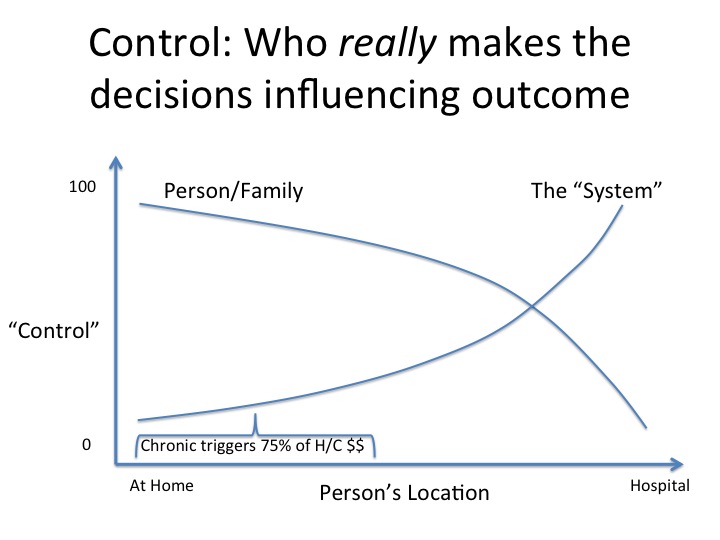
Who is in control of decisions driving outcomes

Who is in control of decisions driving outcomes. Adapted from the Nuka System of Care.

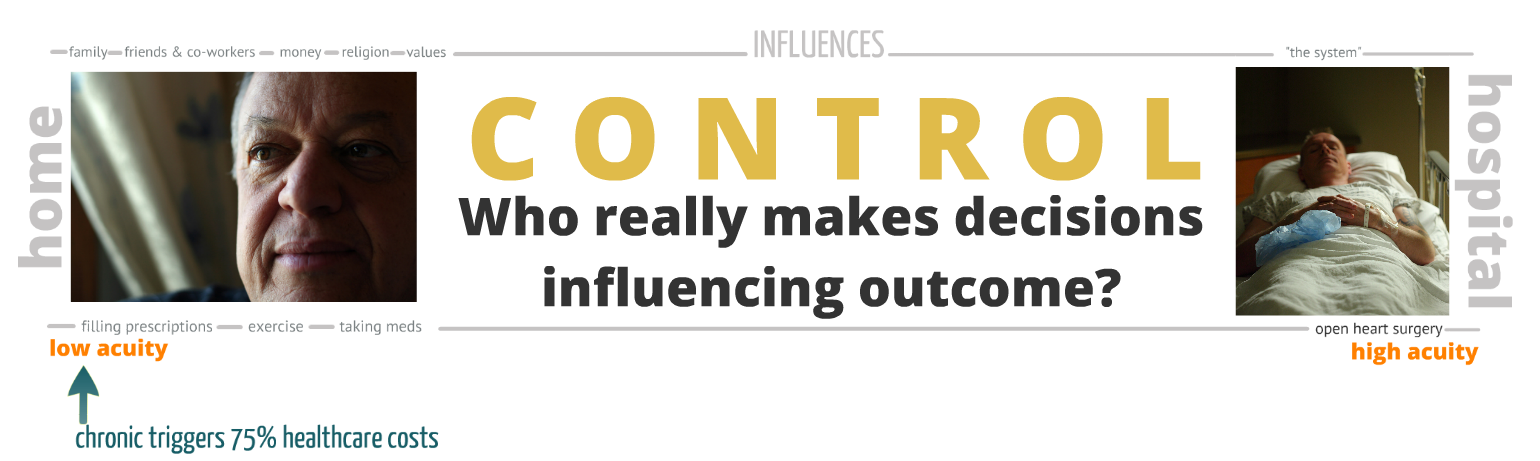
The chart above speaks to the importance of the individual (or family member) in the care process. There are two curves. One is the degree to which the healthcare system is in control while the other is the degree to which the individual (aka patient) is in control. Clearly, when an individual is in a hospital — perhaps unconscious after an accident or during surgery — the healthcare system is in control (appropriately so) of the decisions that drive the outcome. In contrast, the situation is different when one is managing a chronic condition which represents roughly three-quarters of all healthcare spending. In those situations, it is the patient who is control. They decide whether they'll fill prescriptions, take the pills, change exercise or diet habits and so on. Their actions will be the determinant of the outcome.

Top health systems perform extraordinarily well when there is the medical equivalent of a big fire. However, it is individuals who are the key player in keeping small fires from growing bigger and fire prevention. Just speaking to the technology side of the equation, health systems have invested massive sums of money to fight the big "fires" that take place in hospitals. The opportunity for healthtech startups today is to develop the equivalent of CO2 alarms, fire extinguishers, keeping fires from reigniting, fire inspections, and better communication systems that snuff out small "fires" or prevent them from happening all together.

Providers who've slayed the healthcare cost beast

While single digit savings translate into big money in healthcare, there are a few organizations who have had double-digit cost reductions and outcome improvements. In earlier pieces, I have highlighted two organizations that have had impressive results by developing new care models.

There are two others that have particularly demonstrated the importance of individuals and behavioral science. Their leaders are continually looking for ways to improve. As word spreads about their accomplishments, others are seeking to replicate their success.

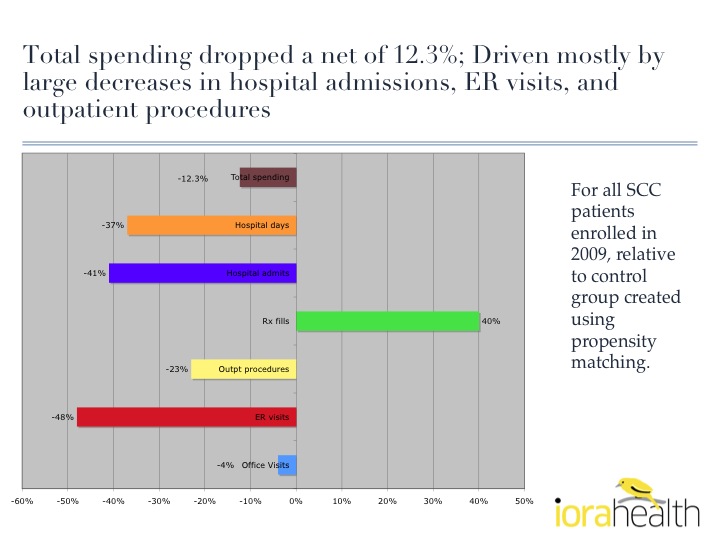
Iora Health's Rushika Fernandopulle was highlighted in Atul Gawande's famous "Hot Spotters" piece from the New Yorker. The graphic below demonstrates their results. Iora Health is one of the pioneers in the Direct Primary Care Medical Home movement  and received $6.3M of funding recently.

Iora Health

Iora Health Reduces Costs and Utilization While Improving Outcomes

The SouthCentral Foundation in Alaska has demonstrated that it is possible to turnaround a government-funded health system (Indian Health Service, Medicare & Medicaid provide 95% of their funds). Their "Nuka System of Care" is a great example of DIY Health Reform driven at the grassroots level. The core insight that has led to truly impressive outcomes has been that for 75% of healthcare spend (chronic disease management), it is the individual or their family who is in control of the decisions that drive outcomes. The graphic below depicts this.

Who is in control of decisions determining outcomes

Who is in control of decisions determining outcomes

The video below is from Mark Begich (Representative from Alaska) describing the results of this model. If you are interested in an in-depth perspective, leaders from the SouthCentral Foundation explain how they do it in two parts.

Some nominal efforts have been made to weave in the individual into the care process. Even simple secure messaging has been held up as a great breakthrough in medicine. I liken the limited efforts to invite the patient into the process to seeing a muddy puddle of water in the Sahara Desert — it's a welcome improvement but far from optimal. The healthcare organizations that will not just survive, but will thrive, are recognizing that a tweak to a system that was designed around the patient as billing vessel won't get the job done.

As we've seen in many areas, tweaks to an architecture designed around a different model never succeed in the new paradigm. If they did, Yahoo or AOL would be the leaders in social media. Expect to see the equivalents of Facebook and Foursquare emerge in healthcare.

Related articles:


20 key points about social media measurement and metrics

Posted 29 March 2012 13:53pm by Vikki Chowney with 2 comments

It's been a week of social metrics and measurement for me.

On day one of this week's Social Media World Forum, held at Olympia in London, I sat in no less than four different sessions on measuring the value of social.

Another discussion this morning, hosted by Waggener Edstrom on social advertising, took a similar line.

I thought it might be helpful to collate some of the quotes, learnings and case studies that were mentioned, to act as further reading or perhaps inspire new models for measurement.

Allister Frost, head of digital marketing strategy at Microsoft

"In terms of social data, we've moved beyond measuring numbers and actions. Do that by all means – but it's easy – the real value lies in getting business-minded people to apply econometric modelling and work out what to do with it."

"I'd like to see Facebook implement a ranking system for 'likes', based on new levels of value – maybe tailored to each brand."

Patrick Salyer, CEO at Gigya

"It's not necessary to change ALL of your success metrics. Socialising your site by allowing sharing etc. increases traffic, conversions & affects existing measurements. This helps people understand in terms they already know."

Reggie Bradford, CEO at Vitrue

"There has to be consistency in measurement. It can't just be about digital, you have to get all your teams together and create unified metrics that everyone agrees on. Otherwise you're at odds before you've even started looking at the data."

Cathy Ma, head of social media at IPC Media

"The holy grail of social media is where business objectives meets user needs and platform/technical capabilities"

"Your three core metrics are: acquisition (cost per acquisition), retention (engagement metrics) and monetisation (value of conversation)"

"In terms of acquisition: Google Analytics' new social media data allows you to track which channels are bringing you new customers, so use it to plan where to spend your time. Then iterate and improve using creative technqiues, and play around with Facebook's Open Graph to extend this. Newsfeed is a great asset."

"In terms of retention and acqusition: Work out how social media helps, use this post on Occam's Razor as a model, track against your competitors."

"Remember that not everything can be measured. You can't teach someone to be charming, sometimes people just are. This covers research & development, and customer insight."

Cathy's full presentation here. 

Alasdair Townsend, business strategy director at Onlinefire

"Brand expectations are severely influenced by big name case studies, don't use those as a benchmark because each company's measurements are individual and appropriate to their own marketing strategies." 

Bryan Tookey, COO at Brandwatch

"Are you being talked about within social media already? Do you have the ears of people within the organisation that will listen when you go to them with social data? Then it's worth monitoring the socil space."

Julie Atherton, planning director at Indicia

 "If you remember one thing, tie your social metrics to business objectives. Otherwise the work you do is useless."

Tac Anderson, VP, head of digital strategies EMEA at Waggener Edstrom's Studio D

"Social advertising can add weight, and numbers, to a social campaign in a way that raises the profile of your work and maximises its value. It's not just about volume, you still have to have a great strategy and authentic content at the heart – but Facebook's targeting features means you can actually do both. Reach bigger numbers of a very specific type of person."

Tim Gould, marketing manager at Casio UK

"B2C and B2B metrics should be different. A consumer facing campaign can produce huge levels of engagement, and potential customers for your pipeline. A B2B one is much more focused and targeted – and so smaller numbers can be just as effective. Managign ex[ectation from a board level means you don't trip yourself up when doing one or the other."

Plus some, thoughts from me:

  • eBay's Sudha Jamthe wrote a great piece on GigaOm last month on key social metrics, which supports Cathy's suggestions above. He includes: social media revenue conversion, which measures how many people become customers through social media referral channels. Facebook engagement, which measures a brand's ability to communicate successfully with their customers on the social network, and social customer support metrics - which measures the impact of customer support on brand health and the cost of staffing a social support programme.
  • IBM's just released a really interesting report called From Social Media To Social CRM (covered here by James Gurd), which includes a diagram on the disconnect between why people connect with brands in social - and why brands think it happens.
  • The Social Media Research Foundation released interesting findings at the Local Social Summit last November, focusing on a tool called NodeXL that uses Excel spreadsheets to allow anyone who has data on people talking about something in the social space to create a map of the relationships between them.
  • NextAnalytics is another spreadsheet-based tool that allows Excel to build and distribute custom social reports, search marketer Ann Smarty also wrote a great overview of measurement spreadsheets last month.
  • iProspect has created a Facebook Engagement Index that combines the number of "likes" a brand has with data from the "people talking about this" metric. It's not perfect, but it's an up-to-date initial benchmark for larger brands.
  • first direct is writing up its experience evaluating the value of PR and social for us, in which it's using a model borrowed from the public sector.

Why mobile email is important for marketers

Posted 29 March 2012 10:59am by Graham Charlton with 1 comment

There was a fascinating stat on mobile email in an infographic we published on the blog earlier this month: 41% of Europeans would either close or delete an email not optimised for mobile. 

The figure is even higher for US respondents (63%) and Asia Pacific (67%), and underlines the importance of optimising email for mobile devices. 

As more and more emails are opened on mobile devices, email marketers need to learn how to adapt their messages to this channel. 

Here, I look at the stats on mobile email and, using survey data from our Email Marketing Census 2012, how well companies and agencies have adapted to the trend...

Mobile email: the stats

The stats show the growing use of mobiles for opening emails, and the extent to which companies are adapting their email strategies to account for this trend.

Use of mobiles to open emails

There are no definitive stats on this, and the proportion of emails opened on mobiles will vary between companies. For example, Gilt Groupe said recently that half of its emails are opened on mobile.

It seems that, in general, around 15% to 20% of emails are opened on email. It's also reasonable to assume, based on the growth of the smartphone, that this is an upward trend.  

  • According to comScore, 67% of smartphone users accessed email through their mobile device in June 2011.
  • Mobile email clients like the iPhone, iPad and Android have grown from 4% of the market to almost 20% in just two years. (CampaignMonitor)
  • According to Knotice, Mobile devices accounted for 20.24% of all email opens, a jump of 51% compared to Q4 2010. 
  • Knotice also found that just 3.09% of the sample of 701m emails were opened on both mobile device and desktop . Of that 3.09%, only one-third were opened on a mobile device first, then viewed on a desktop device later.
  • According to Return Path stats from 2011, 16% of emails are opened on mobile devices: 

Return Path's stats show our data shows an 81% growth in the accessing of email via a mobile device. That growth has mainly come at the expense of webmail access, with desktop use remaining steady. 

What if emails aren't optimised for mobile? 

Whereas many marketers may assume that recipients would simply wait and read emails not optimised for mobile when they are in front of their laptop or PC, a recent e-Dialog study tells a different story. 

29% of Europeans would read emails later on a laptop or PC, but 41% would delete or forget about the email. 

That's a huge missed opportunity for email marketers, and APAC and US recipients take an even harder line. 49% of US and 50% of APAC email recipients would just delete. 


Are marketers aware of the opportunities? 

Stats from our Email Marketing Census 2012 suggest that many need to wise up to the opportunity. 

The stats show that a large number of companies do not have any strategy in place for this, with 39% reporting this as "non-existent", and 37% saying their strategy was "basic".

How well would you describe the extent to which your company has (or clients have) a strategy for optimising email marketing for mobile devices?

48% of agency and company respondents are unaware what proportion of emails are opened on mobile devices, which means they can't even assess the opportunity to begin with. 

What proportion of emails you send are read on mobile devices?

Case studies

British Airways/e-Dialog

Last year's winning Innovation Awards entry from e-Dialog and British Airways shows the importance of optimising emails for mobile devices, and the results that can be achieved by doing this.  

First of all, BA's database was used to determine which recipients were opening emails using mobile, and which device they used. 

Then four different emails were created, for desktop, iPhone, Android and Blackberry, so that recipients could have the best version of the email for their phone. 

The results were impressive, with open rates for mobile exceeding those for desktop users, in excess of 50% for iPhone and Android devices. The CTR was 25% for users who accessed email on their iPhone and in excess of 30% for BlackBerry users.

The campaign generated over 250,000 downloads, more than double the targeted number, and more than 70,000 clicks to BA.com/apps. Approximately 200,000 downloads came from the Apple App Store, 50,000 on BlackBerry and 7,000 on Android.

STYLECampaign / SavvyMoms

In this case study, STYLECampaign designed mobile optimised welcome emails for SavvyMoms, learning from data which found that 78% of 'moms' use email on their smartphones. 

SavvyMoms had mobile usage of more than 20%, so designing for email made sense. The case study shows the three different versions designed for mobiles. 

The first email in this series saw a 3x lift in click-to-open rate, and 12% of those who opened the redesigned email on a mobile clicked, compared to 6% who opened on the desktop that clicked.

Conclusion

It's clear that the growth of mobile email usage presents a challenge for marketers, and the first step is to identify the proportion of your emails which are opened on mobile. 

The next step is to check what your emails look like on these devices. As Tamara Gielen of Plan to Engage said in our Email Census: 

If the percentage of mobile readers is below 5%, then I would just make sure that your emails are readable on a mobile device, once you see the number of mobile readers is above 20%, I would consider seriously adapting your email templates.

For more on mobile email best practice, I've asked industry experts about the importance of optimising for smartphones, and the design considerations. 

Israeli-American Accelerator UpWest Labs Graduates Its First Batch Of Startups

When it comes to countries with thriving startup ecosystems, Israel ranks among the best. With nearly 5,000 startups currently in business — second only to the U.S. — the country's pool of entrepreneurial talent has been attracting Western businesses and entrepreneurs for years. But, in January, Gil Ben-Artzy and Shuly Galili launched a startup accelerator that aims to reverse this trend in favor of Israeli entrepreneurs, by bringing the country's promising founders to Silicon Valley to help them kick start their businesses. And, today, after 10 weeks of mentoring, networking, and iterating, UpWest Labs is revealing the six graduates of its inaugural batch.

As Eric pointed out last month, while Israel has a thriving startup community, challenges remain. The market is small (Israel is the 100th smallest country in the world), and Israeli venture capital has been making a shift to focusing on late-stage investments. So focusing on early-stage businesses, gathered in small cohorts, is important to UpWest.

Galili also tells us that UpWest is currently the only accelerator in the U.S. that focused solely on Israeli startups. Of course, while its entrepreneurs are unique in that sense, UpWest is emulating the litany of accelerators and incubators that have popped up over the last few years, in the sense that it's bringing entrepreneurs to its offices in Palo Alto, offering them housing in Menlo Park, access to a long list of local mentors, and is providing seed funding in the $15K to $20K range in exchange for up to 8 percent equity.

Though its model may sound familiar, UpWest knows it has to differentiate if it wants to be around for any significant amount of time. So, as opposed to the traditional approach of accelerators, which generally focus on ambitious founders slinging tons of ideas, UpWest is focused on finding entrepreneurs who have already built products that have found some traction, so that they can use their time in Silicon Valley more effectively. UpWest also aims to keep its class size small in order to provide companies with maximum attention.

After officially opened its doors in January, shortly thereafter welcoming its first class of entrepreneurs to the Valley. As a new generation of consumer-focused startups has emerged in Isreal over the last few years, UpWest is looking to build a valuable resource for this new set of companies tackling the consumer Web.

Last week, the accelerator graduated its first-ever batch of startups, including mobile, social, gaming, and SaaS companies. Six startups are officially being released into the wild, and below we're offering a glimpse into what makes them tick.

Contapps is a universal contacts platform designed to help you connect, however you want, with the people you care about. The startup is operating under the assumption that the tools and networks we use to communicate all live in apps in our smartphones that scattered all over our phone, so Contapps has built an app that puts contact info front and center.

The "contacts platform" brings together free SMS, Facebook, Twitter, and more so that you can choose the best medium to reach out to your contacts — all in one place. The startup's Android app has racked up over 500,000 downloads, and an average 4.4 star rating across 5,500+ reviews.

OffScale is a database version management platform — or, in its own words, Git for databases — aimed at allowing businesses to focus on creating faster product development cycles and releases by taking the hassle out of copying and managing their databases.

OffScale wants to help you organize and manage those snapshots you take of databases, including offering easy rollback, even if your database runs in a third-party cloud, as the software runs the same on your laptop and on the virtual server. The startup is also offering the ability to create and maintain datasets for automatic testing, along with the protection of being able to speedily tag and restore databases. Offscale is currently in beta, and while in beta, the software is free to download.

Tradyo likens its used goods marketplace to a "StumbleUpon for tangible things." The startup's iPhone app enables users to buy and sell used goods in your area in realtime. The app uses GPS to reveal the cool stuff available around you, allowing you to sell an item, search your community for cool stuff, and receive push notifications when an item you want gets listed, or when someone wants to buy what you've listed.

Like Antengo, Tradyo wants to improve upon the mobile craigslist model in an attempt to make classifieds safe, easy, and realtime — in other words, leveraging the popularity of the collaborative consumption movement to re-imagine what it means to shop locally.

Senexx is using its patent-pending technology to help enterprise organizations identify and manage expertise via an internal Q&A platform. The startup's advanced parsing and knowledge-routing algorithms aim to reduce the amount of time it takes for employees to find answers or domain experts with specific knowledge in a particular subject within their company. This is complemented by the ability to catalog past solutions to certain events or situations — the overall goal being to streamline in-house expertise in order to more effectively deal with problems, or opportunities.

The startup's private, cloud-based service integrates into your company's exiting enterprise networking platforms to allow it to take advantage of current collaboration systems, whether it be email, instant messaging, or internal social networks, in an effort to improve cross-team collaboration. To find out more about pricing, contact the founders here.

Bfly is a "mobile experience" which enables users to connect to other people, locally and around the world, using a virtual, 3-D butterfly of all things. The startup is currently in private beta, and will be launching its iOS and Android mobile apps in the next few months. But from what we can tell, Bfly is almost like a mobile, virtual chain letter. Each user creates a unique virtual butterfly and passes it to a friend's mobile device when they cross paths.

According to Bfly, as the butterfly hops from one mobile devices to another, users can track its journey, view stats and photos taken by other users it meets as it goes. The startup is obviously looking to tap into the far-reaching potential of mobile technology to give users a fun, somewhat serendipitous, and quirky way to meet new people.

Invi is currently in stealth mode, so the team isn't saying much about its product, other than the fact that it is trying to reinvent SMS, and perhaps iMessage along the way, by building a next-gen texting app for mobile devices. If that piques your curiosity, you can sign up for the startup's beta here.