domingo, 24 de noviembre de 2013

Speed and security: how to win the mobile race

We know that we are addicted to our mobile devices and love that they enable us to purchase anytime, anywhere.

So chances are that one of your next purchases will be via your tablet or mobile phone.

But what does this mean for businesses operating in the mobile space?

Over 13% of all web browsing is done on a mobile device,  a percentage that has doubled in a year, and this rise is at the expense of the static computer, which is decreasing at a similar rate.

With the mobile commerce market on target to reach $25B in 2013, businesses are facing a huge opportunity that currently presents a major challenge: speed.  

Stats from Gomez show that the majority of users expect performance levels close to that on desktop: 

The stats also show that: 

  • 57% have experienced problems when accessing a mobile site. 
  • 46% would not return to a poor performing site. 

However, the average load time for an mobile commerce site is over seven seconds. It is estimated that the frustration caused by these five seconds accounts for over $1B in lost revenue per year, a good amount of brand dissatisfaction and even a healthy number of frustrated mobile consumers who throw their phones while waiting for slow pages and apps to load.

?Worse than throwing phones, annoyed users leave your shopping pages and seek out the competition. Around three-quarters (74%) of users will leave a site after waiting five seconds for a mobile site to load (remember that average was over seven seconds), and a quarter (26%) will visit a competing site.

But even if they're satisfied with performance, consumers may also become suspicious of mobile data collection and sharing policies. Apps and sites that hold sensitive information, the health or banking sectors are examples, need to be particularly careful about keeping consumers informed of their data sharing policies.

The market is expanding quickly, but slow performance and distrust are significant obstacles to growing revenue. So what can companies do to improve both performance and privacy in their mobile environments?

Companies struggle with issues relating to performance and trust when they do not have control of the third-party elements running through their mobile sites and apps.

The average mobile website contains over forty unique third-party tags and, while they provide useful services and analytics for site owners, they can also slow page load speed. The most effective way to minimise this impact is to better understand the third parties with a presence in your mobile environment.  

While it may seem obvious that websites should know the companies that have tags on their site, there have been many factors that have resulted in the mobile environment not being developed in a well-organised fashion. Historically, companies were often in a rush to get mobile apps into the market and needed to work with new third parties who were unknown in the desktop space.

While the tools to properly monitor these tags did not exist in the early 'Wild West' days of mobile, this is not the case now; the market is maturing and websites can now make sure the marketing elements on their websites are under control.

In order to gain control, you need to have a full list of trackers, both directly-placed and delivered by third parties, on your mobile sites and apps.

Once you know who the companies are, you can then look at the impact each element has, as well as what data the third party is collecting about your consumer and what they do with this information.

This can then help you optimise the performance of your website. You may decide to use a CDN to reduce third-party calls on page load, or to work with a tag manager to improve tag structure.  Once you have improved performance be sure to continue to monitor for slow elements – do not let any disrupt your carefully streamlined mobile experience.

In terms of privacy risk, the map may direct you to solidify data collection agreements with your vendors, or offer better options to your consumers to voluntarily opt out of some tracking. 

Five seconds could make the difference between a purchase from your site or that of your competitors. Take the time to review the trackers on your mobile site, and the reward will be an increase in site visits and climbing mobile revenue numbers.

Free Massive Online Education Provider, Coursera, Begins To Find A Path To Profits

Online education providers may very well disrupt the higher education establishment, but, first, these for-profit companies need to find a way to finance the mammoth technical infrastructure needed to support millions of students. It's a challenge that all mission-based businesses wrestle with, and why many have wondered whether Massively Open Online Course (MOOC) providers will ever become big business — or be around in five years — let alone "transform higher education," as they've so often promised.

Today, one of the biggest MOOC providers on the Web, Coursera, showed skeptics that it has indeed found a way to monetize free educational content and may just be on the road to riches. In a blog post this afternoon, Coursera announced that it has raised over $1M for paid certifications, which verify that students passed (an otherwise free) online college course.

For those unfamiliar, Coursera partners with top-tier universities — more than 83 institutions on board — to make their classes and lectures available online, for anyone in the world to consume. The company burst onto the scene with millions of dollars in backing from big names, and ever since its buzzy debut has been dogged by questions over whether or not MOOCs will ever be able to make enough money to justify $65 million-worth of venture capital.

In July, Coursera added a significant round of funding (bringing its total to $65 million), saying that it would use its new capital to develop mobile apps and increase its presence internationally (among other things). Of course, with so much capital and so many investors now on board, Coursera's road to monetization and profitability became that much steeper.

The news today is reason enough for optimism, especially considering how quickly it has been able to turn a new feature into $1 million in revenue. The startup unveiled "Signature Track" back in January — a program that has been designed to allow students to earn "Verified Certificates" for a small fee.

Through Signature Track, students are able to verify the work they complete on Coursera, with the idea being to supplement the value of the work students do on the platform. While this represented Coursera's first step (really, tiptoe) into credentialling and doesn't include credit towards a degree program, it does give students something tangible to prove that they've completed the course and know the material.

While $1M every 9-months wouldn't pay back their total $65 in investment, there's every reason to believe that there's orders of magnitude more students who would pay for this service. First, beyond being nine-months-old, Signature Track really hasn't been aggressively promoted. Second, Coursera is quickly expanding to more universities, both in the U.S. and around the world.

Third, and perhaps most importantly, tech companies are exploring an alliance that would weight these types of certificates as equal to a college to a degree in the hiring process. While this Alliance is still very much in the nascent stages of development, if MOOC providers like Coursera and Udacity are able to come together with the Googles and Apples of the world to develop some kind of standard, it could have big implications for higher education.

In the future, we could see these platforms (and others that are sure to launch in the interim, like MOOC.org, for example) allow students to mix and match classes from MOOC and traditional universities, with MOOC providers offering some kind of paid certificate to its students.

There are, of course, many very valid concerns that need to be discussed as MOOCs, tech companies, startups and schools themselves rush to integrate technology and tear down the ivory walls around traditional higher education. Questions like these are becoming increasingly important to ponder: Are MOOCs best used as a platform for continuing education — to re-train, brush up on subjects and for general edification purposes — or as a viable alternative (or even replacement) for the traditional college degree?

For now, it's the former, but as Coursera and others plow more time, resources and capital into their Signature Track-style programs, the more they will compete with campuses, institutions themselves — and the diploma. This is a great thing for education in the long run, as long as Coursera and MOOC providers aren't just content with the bar set by traditional education, but look to push that bar higher. That's what we want to pay for, and that's what will shape the next big education technology business — not just a digital version of the same old thing.


sábado, 23 de noviembre de 2013

Five requirements for a mobile media strategy, and how the UK’s news sites meet them

It's no overstatement to say that mobile technologies have revolutionised the way we consume news.

In a recent survey of 1,000 UK consumers, news was only behind social networking and looking up directions as the most popular reason for browsing on a mobile device. 

For the over 45s, news is the most important reason to browse on mobile.

What's more, the research found that mobile hasn't just matched print and desktop in consumer preference for consuming news, it has surpassed both to become the favourite way to get the headlines. Just 19% now prefer print and 23% desktop, compared to 42% who'd rather read on mobile. 

So there's no denying that mobile is important to consumers and, by extension, it must be to publishers. Adam Tinton of Reed Business Information reckons media brands have six months to get themselves a mobile strategy, but what are the key components to address in it?

We benchmarked 12 of the UK's biggest news publishers to find out how they were doing.

Personalise and contextualise

Personalisation is a hot topic in digital marketing, and it is even more important on mobile where your audience has less time to browse around for relevant content. 

Keep context in mind, in terms of device and location. On a smartphone readers want the headlines relevant to them, as quickly as possible, but that may change on a tablet device where they are browsing more leisurely and have the screen space to take in more.


The FT's web app is a good example here, adapting intelligently to the device. It offers you a personalised home page when signed in and giving you the option to see either live content or articles from that morning's print edition.

Search and value add

As with personalisation, the potential time constraints of mobile devices make search important too. Search functionality must be clear and easy to find, allowing users to find the content they are looking for quickly.

The Independent adds value in this respect by allowing users of its iPad app to 'favourite' articles for quick access later.


The importance of community

An established method of building engagement on desktop sites is also of great important on mobile, allowing users to share and comment on articles.

As mentioned, social networking just about topped reading news in top mobile activities in our consumer research. 

The GuardianWitness app is a great example of this. Dedicated to the publisher's strong online community, it enables users to act as citizen journalists and really get involved by submitting their own content.


Align the look and feel

As a media brand, your audience is your main asset, and as in our tips for mobile commerce, providing a unified experience across devices is key to achieving loyalty.

Try to make UX elements as universal as possible, and ensure that mobile sites and apps all have similar design elements to maintain a coherent look and feel. 

Mail Online's iPad app has a good approach, using some of the additional functionality that is afforded on a touch screen while echoing the branding and some of the layout of the desktop site. 

Be speedy

When it comes to consumer expectations from mobile sites, our research found that speed is the most vital aspect. And it's the biggest problem people come up against, as 49% cited slow load times as the most common issue they have when browsing on mobile.

Of course there are elements here which may be out of the publisher's control, but network speeds notwithstanding it clearly makes sense to ensure the load time of your mobile site is super snappy in order to deliver readers their headlines as quickly as possible.

In our benchmarking, we were particularly impressed once again with The Guardian. Its mobile site loads very quickly, keeping the frustration of waiting to get the latest news to a minimum.

With the mass adoption of mobile as a medium of consuming news, there is a huge opportunity for publishers to take advantage of here, and only a short time to capitalise on it.

5by Wants To Be Your Web Video Concierge, And It's Taking Aim At Phones And TVs, Too

I like to think we've all been here at one point: You're bored out of your wits and rather than try to do something productive, you just spend hour after endless hour on YouTube. The problem that tends to come up in those situations is that, after a while, you just can't find videos that strike your fancy any more. Tragic, I know.

As it happens, that's exactly what Greg Isenberg, founder and CEO of a Montreal-based web video startup called 5by is trying to fix. 5by takes a decidedly different approach to how it finds and plays videos for you, though it may look a little familiar if you've spent some time mucking around with mobile music apps.

5by has been called the Songza of video, and it's not hard to see why. Once you mosey over to the website, you're greeted not by a smattering of videos but by a series of categories like "Blowing You Away" and "Killing Time." Clicking any of those categories brings you to a slightly more granular set of options to choose from (think "Animals" or, my personal favorite, "Space"), and one more click takes you straight into a video (culled from YouTube or Vimeo) of 5by's choosing.

When you're in a video, you're presented with a series of reactions: you can hit buttons to signify that you've laughed at the video being shown to you, hated it, or felt it tug at your heartstrings. And if a video just isn't your cup of tea, there's always a skip button to take you far, far away. While all that skipping or liking or OMG-ing is going on, 5by is quietly taking all of those little interactions and learning what you do and don't like so it can serve you a video better suited to your tastes the next time around.

5by-videos

It sounds like a simple enough concept, and Isenberg says it's working very well so far. He and the rest of the 5by team launched a very lean version of the site at the Launch conference held this past March, and in the days that followed, 5by attracted thousands of visitors who stayed on the site for about 12 minutes. These days, that average time on site has jumped to 19 minutes, and Isenberg says that the site has curated about 100,000 videos for its users to gawk at.

At this stage, all that content curation is handled by the small 5by team, with a little help from a curation algorithm designed to bring in high-value video from multiple sources. The algorithm knows to pull in videos from popular sources like Vice and Epic Meal Time and sort them into the proper categories for users to discover. But that process of curation won't remain in-house for too much longer. Part of the 5by monetization plan hinges on a CPV model like the one StumbleUpon leans on, but Isenberg says companies are starting to sign on as curators and push their own videos to viewers who like video categories or certain kinds of videos.

It's no secret that the line between video content and the ads that go in between those videos has grown awfully murky, and sponsored content on websites like BuzzFeed show that there's a decent chunk of people who don't mind mixing content and advertising. Now third-party curators can target certain types of users to receive videos and native ads (remember, 5by can figure out what you like and what you don't) and Isenberg says Playboy has signed on to be the first one.

The thing that hasn't eluded the 5by team is that, as enthralling as a leanback web video experience can be, there's only so much leaning back you can do when you're plopped down in front of your computer monitor. As far as Isenberg is concerned, the future of 5by will rely on branching out from traditional PCs. They're working on an iOS app, and it ditches the web version's category view in favor of a greater focus on how much free time you have to blow.

Isenberg also confirmed that 5by has already engaged in talks with two major television OEMs about the prospect of baking 5by into their forthcoming smart TVs. Why? Well, for lack of a better term, the YouTube experiences you'll find on most smart TVs are generally pretty lousy. It's still early days for 5by, but I've already found myself wasting more time there than I care to realize — if Isenberg's cross-platform expansion plans pan out, we could all be in a bit of trouble.

How RS Components uses automated email FTW

RS Components distributes sometimes cool and sometimes boring electronic and industrial components.

Last week I attended Responsys Interact 2013 and listened to Harriet Mitchell, Ecommerce Behavioural Marketing Manager at RS Components.

Later that day, RS Components won the Email category at The Digitals, and so I thought I'd share the how, what and why. 

On the back of an RS Components business card, you'll see the following:

Those numbers must bring all sorts of (exciting) challenges, not least for CRM and email. 

Firstly, to continue with numbers, RS has more than 1m active email contacts, and sends over 3m emails every month, in 20 different languages. So, RS must have known that getting email right, with a sensible programme of triggered messages, could lead to a serious increase in sales. 

And, indeed, RS' objective was to increase conversion through increasing relevancy of communications with email automation.

New opted-in users enter the campaign contact flow, and receive different emails depending on their position in the lifecycle. The key parts to this contact flow are the 'welcome', 'nursery', 'maintain' and 'lapse' programmes.

RS began with some key automated emails, and moved on to slot more triggered messages into the customer lifecycle.

First campaign: basket abandoners

The first fully-automated event-triggered email implemented was the abandoned basket email. There were 27 versions sent daily, worldwide. Here's one in the language of love (a clue, it's not HTML).

The rules of this communication were as follows:

  • Sent to contacts that have abandoned a basket within the last 24 hours. 
  • Must not have purchased anything from RS in the last two days. 
  • Must not have received an email from this programme in the last 15 days.  

What's really interesting is that RS efficiently combines its offline sales data with its online data, in its sales system. Once this data is in, RS can ensure that anyone that has abandoned their basket online but also purchased recently offline doesn't get an email asking them to purchase.

This simple but effective set of rules increased conversion by 7%.

The lapse pilot

The idea with this campaign is to prevent customers from lapsing, rather than having to win them back. Criteria as follows:

  • Sent to contacts that are likely to lapse based on their individual aggregate objective function (AOF).
  • Must not have received an email from this programme in the last month. 

This simple email programme increased incremental conversion by 1%. 


Further programmes: success targeting behaviour not content

The table below shows the criteria for automated emails that were slowly introduced. Everything from 'quoted offline, but not converted' to 'encouraging product review' to 'browsed online but didn't buy'.

Obviously with the addition of these programmes, further segments became apparent, as it was important to ensure that programmes didn't interfere or cross over unproductively, creating mixed messaging.

An interesting point arises here. RS was more successful when targeting behaviours i.e. browsing or abandonment, than when targeting specific products.

This is because the recipients of the emails are not always the end-users of the products, but buyers within a business, and so content related to an obscure electrical component isn't always enticing or persuasive.

Brave new world

For a catalogue electronics company, however big, the move to a sophisticated online retailer is a fascinating one.

It's clear that the idea of event-triggered email automation is simple, and the campaigns mentioned here make sense. Doing it hasn't always been easy. The arrival of cloud-based technology such as Responsys Interact means many retailers are starting to join the dots with their email, and the results show that it's an incredibly powerful form of marketing.

Results:

  • Welcome Email Programme: open rate 47%, click rate 13%.
  • Nursery Email Programme: open rate 34%, click rate 6%.
  • Product Reviews Email Programme: open rate 29%, click rate 4.5%.
  • Abandoned Basket Email Programme: open rate 38%, click rate 19%. 

viernes, 22 de noviembre de 2013

The Science Of Reddit: Why Some Ideas Dominate The Net

The Internet is not a perfect meritocracy, where the best ideas naturally rise to the forefront of the national conversation. It is easy to game the popularity of some ideas by exploiting the fact that Internet users are overly optimistic sheep who blindly rate the value of stories positively if they first see that others already liked it. In a brand-new study, one of my favorite researchers, New York University's Sinan Aral, found that he could experimentally boost the popularity of articles 32 percent on a news aggregator, like Reddit.com, by posting them with an initial few likes.

The first-of-its-kind study not only helps us determine why some ideas are more popular than others, but also alerts us to the ease at which important sites are gamed by nefarious groups.

The Study And Why It Works

Aral and his colleagues posted news stories to an unnamed aggregator over the course of several months, experimentally manipulating the initial number of likes and comments on each story. On balance, stories which were given an early boost ended up being more popular, compared to those that had no initial likes.

"Positive and negative social influence created asymmetric herding effects," writes the research team. "The positive manipulation created a positive social influence bias that persisted over our five-month observation window."

Indeed, Internet users are so systematically optimistic that they tended to reverse the articles with initial negative ratings. Thus, while the Internet tends to exaggerate positively valued stories, the same bias does not afflict negatively valued stories.

While Aral doesn't speculate on the underlying psychology that fuels this bias, other researchers have found that users like to share positive stories. "When you share a story with your friends and peers, you care a lot more how they react. You don't want them to think of you as a Debbie Downer," said University of Pennsylvania social psychologist Jonah Berger.

It makes sense: sharing a story impacts our own reputation. No one wants to be the Internet's sad sack.

Why Libertarians And Gay Rights Dominate

The study reveals why ideas with a rabid core of supporters will tend to dominate online discussions. A hyper-active minority exaggerate the popularity of an idea and trigger the Internet optimistic hype-machine. Indeed, while libertarian Ron Paul had minor national support as president, he dominated online discussions, receiving a greater share of positive social media chatter than the person who actually won the Republican primary, Mitt Romney.

The same goes for gay marriage. Up until a year ago, the public was largely split on the issue.

twitter-more-liberal1-1

Yet, Internet users, which tend to be young and liberal, helped turn the web into a machine for viral pro-gay marriage content. Pro-gay marriage groups on Facebook had between 7 to 100 times more followers. Content, such as news of this rainbow-colored house across from the ant-gay Westboro Baptist Church, tends to get in front of our eyes.

392926_428888173871489_902862007_n (1)

This means that the preponderance of viral content will reflect the most hardcore users, not the general public

Gaming The System

Our sheep-like tendencies can also be exploited by nefarious partisans. Back when Digg.com was king of the news aggregator hill, a clandestine conservative contingent, Digg Patriots, banded together to vote up (and down) stories. It not only wreaked havoc on Digg's reputation, but got the group's ideas far more coverage than they otherwise would have had.

"When small groups agree to vote an item up early on, it can inspire herding and accumulating positive votes. This creates an incentive for manipulation. If this process holds for articles, then the signals of quality on those articles can be biased and inaccurate," Aral writes to me in an email.

Digg Patriots ultimately got caught, and news aggregators have attempted to design algorithms that identify and neutralize conspiratorial groups. Arals study proves that it's still possible to game the system, but not whether it can be done on political issues or whether it's enough to make stories go viral. A 32 percent boost in popularity is nice, but a true viral story will get between 100K to several million views.

Still, it does show that the Internet is not a perfect marketplace of ideas. Ultimately, the net will reflect humanity's own psychological biases.

Nokia Had A Stunning Q3 In North America, With Device Volume Up 367% From Last Year

According to its most recent earnings report, Nokia appears to have finally found market traction in North America for its Lumia line of Windows Phone-based smartphones. This bears well for the platform itself, and Microsoft, who is buying Nokia's device business for more than $7 billion.

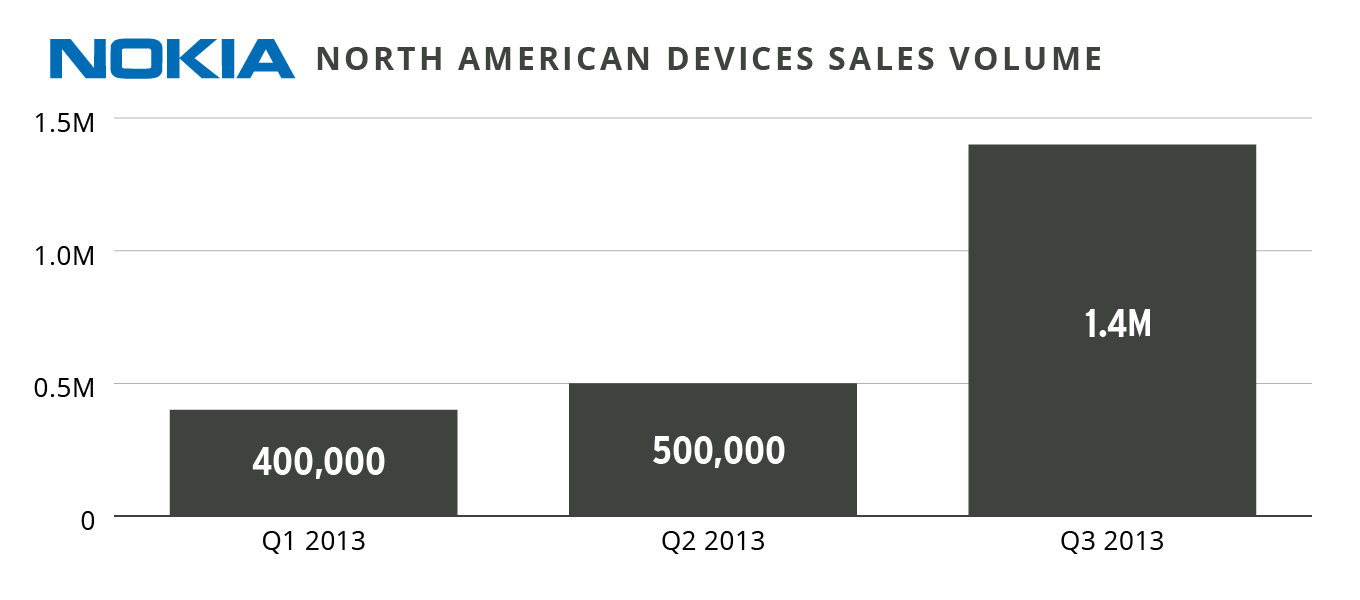
Nokia's device unit volume in North America spiked from 500,000 units in the second quarter of 2013 to 1.4 million devices in the third. For comparison, in the first quarter of this year, Nokia shipped 400,000 devices in North America. In the year ago third quarter, that figure was 300,000. To therefore have Nokia almost triple its volume in the region in a single quarter, comparing sequentially, is more than surprising.

According to Nokia, the "sequential increases [in North America] were primarily due to higher sales in our Smart Devices business." So, most of the sales delta is smartphone-based. And, given that the mobile market in the United States is a far larger mobile market than Canada, it can be presumed that most of the sales took place south of the border.

Therefore, Nokia sold far more Windows Phone handsets in its third quarter than it had in the preceding quarter. Estimating roughly, it could easily be posited that Nokia sold more than 1 million Lumia devices in the United States in its third quarter.

Here's the graph:

nokiaglobalsales2a

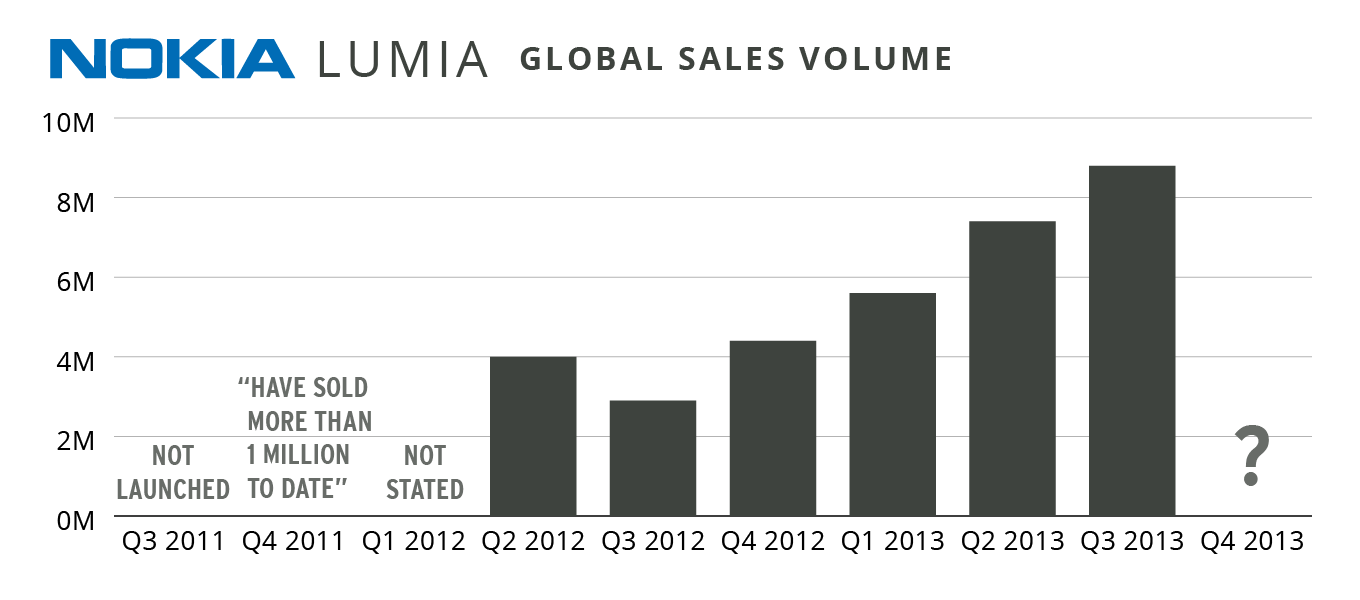
The Nokia Lumia line of smartphones was released in November of 2011, during the company's fourth quarter. In that period, the company later noted that it sold "well over 1 million Lumia" devices.

In the following quarter, the first of 2012, Nokia did not disclose Lumia sales figures. In the second quarter of 2012, it reported 4 million units were sold during the period. From this we can surmise that Nokia enjoyed modest, but quickly expanding sales rates of its Lumia line.

However, in the third quarter of 2012, sales fell to 2.9 million units, a very troubling point for the company. Nokia blamed it on having "shared the exciting innovation ahead with [its] new line of Lumia products."

From that point, Lumia sales have expanded in each sequential quarter, from 4.4 million in the third quarter of 2012, to 8.8 million in the third of 2013, Nokia's most recent quarter. Here's the chart, so you have the full picture:

nokiaglobalsales1a

So, global growth has been steady, and in the fourth quarter Nokia could sell more than 10 million Windows Phone devices, breaking that threshold for the first time. Contrasted, however, with its North American sales, you have to appreciate the company's struggle: While its global operation was expanding and ticking right along, North America was stuck.

Introduction of the Lumia 520 (and 521) on the low-end, and the Lumia 1020 on the high-end, coupled with the software improvements in Windows Phone 8, appear to have unlocked, at last, the keys to growth in the United States.

This matters because if Nokia failed to ignite growth in this market, it would not be out of the question that its carrier support would have been in jeopardy. And once lost, such support is difficult to rekindle. Therefore, the strong quarter implies that Nokia's long-term prospects in the U.S. market are at least alive.

–

Nokia's Windows Phone strategy has long been panned by critics as doomed, helpless, hapless, perfidious, and expensive. Microsoft's Windows Phone strategy has been pilloried in the same way. Now that the two are joining teams, the opprobrium can be aimed at a single entity, saving time. Kidding aside, Nokia – which is the de facto Windows Phone OEM, period – proved that it could ship volume on the platform several quarters ago. But the North American question lingered: Could Microsoft's own platform sell in its home market? After years of slog, the answer is now a firm maybe.

So what to look for? Sequentially rising Lumia volume in North America. If Nokia moves, say, 2 million devices in the fourth quarter in the region (and again notes that the rising device figures are based on smartphone sales), we'll have a ball game.

All data via Nokia.