lunes, 31 de diciembre de 2012

With A Flick Of The Wrist, Facebook Could Destroy Current Advertising Models

Advertising is something that we've all grown accustomed to in today's society. For companies that provide free services, it's an important part of keeping those services free for everyone to use. But are ads even working on us anymore? That's up for debate and discussion, and those are decisions everyone can make for themselves.

One of the biggest companies ever facing the conundrum of introducing advertising is Facebook. The social network is inherently made up of people, and in turn, their content. There's private content, personal content and public content. Facebook is trying to monetize as much of it as it can to keep its shareholders happy, the service free, and its users from leaving for another option, of which there are none to speak of at the moment.

No matter where the advertising is placed, it'll either rub people the wrong way, or will be ignored completely. Here's what Mark Zuckerberg, Facebook's CEO, has been quoted as saying regarding ads:

Advertising works most effectively when it's in line with what people are already trying to do. And people are trying to communicate in a certain way on Facebook – they share information with their friends, they learn about what their friends are doing – so there's really a whole new opportunity for a new type of advertising model within that.

Is that "new" advertising the future or is it more of the same? Remember those flashing animated banner ads on websites in the early 2000?s? They were annoying and people didn't really click on them. Just ask Myspace. Sure, they got some clicks, but only because advertisers became sneaky enough to turn them into "games" and interactive modules using Flash. They still sucked, though.

Where Myspace failed, Facebook has a real opportunity to capitalize on the fact that ads are just not so good for the user's experience. How, you ask? By offering an option to turn them off, something that has worked for services like Amazon's Kindle, Pandora and Spotify recently. Yes, they are different, because they are offering up entertaining content. However, that Facebook content is entertainment, especially since a lot of people spend a lot of their free, and busy, time on it. On mobile devices, there is way less real estate for unwanted content. Good thing that Facebook stopped working on them for a while.

Making Something You're Proud Of

Zuckerberg has also made this statement time and time again:

What really motivates people at Facebook is building stuff that they're proud of.

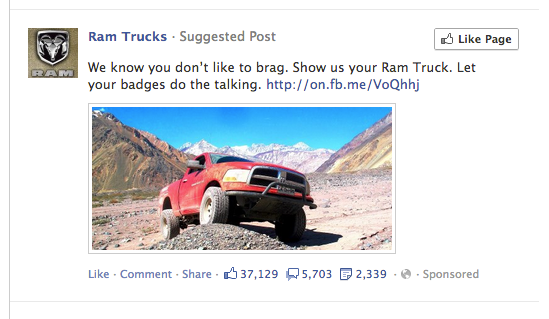
As I used Facebook last night on the desktop, I wondered, as I'm sure many of us have, "Is this something that Facebook employees are really proud of?" Have a look:
Screenshot_12_29_12_8_14_PM

For whatever reason, this advertisement from Dodge was shoved into my News Feed. It's probably because one of my friends liked their page at some point in time. However, that's where it stops making sense. I don't like trucks, Dodge, anything with the word Ram in it, and I prefer to take the train. This isn't about me, though. This story is told at bars everywhere when it comes to Facebook ads. The lack of "targeting" isn't really a shortcoming, it's a near impossibility. Knowing what people want to see and when they want to see it is human, not algorithmic. Sentiment and moods can't be measured in 1?s and 0?s.

Facebook shows popular content on your News Feed with its magic algorithm. What happens with this "advertorial content" is that brands pay money to get it in as many faces as it can, maybe a thousand people "Like" it, and all of a sudden, it becomes "popular." It's not organic, and it's not something that we really wanted to see in our feed of friendly content.

Is that experience best for users, or even advertisers at the end of the day? No.

What's Best For Users
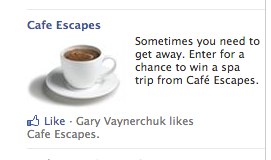
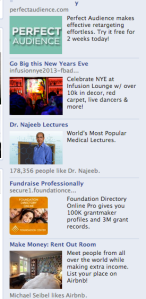
(10) FacebookUsers should be able to do what they do best on Facebook, which is update their status messages, share photos and video, and add new friends. They should be able to play games, talk to their parents, have a video chat and find old high school mates, without interference. All of the ads along the right-hand side of the News Feed, and every other page on Facebook just about, are distracting. Users are being distracted from what Facebook makes its money off of, our information.

The more a user is interrupted when interacting, the less they'll use a product, even if it's just by a tiny bit. It's a pretty obvious fact, and something that Facebook is most certainly aware of. The position that the social network is in now, is that most of its users are addicted to the site, and there are plenty of people to fill gaps when one or two fall off. Over a billion users is ridiculously massive.

All of this is somewhat obvious, but it's something that should put fear into marketers' minds. The worse these ads are, the less targeted they become, the more pissed off users will be, thus not caring about your brand. The next time I see a Dodge Ram commercial on TV, I'm going to remember that obnoxious ad that I saw on Facebook. Did that help sell trucks for them? No.

How Advertisers Should Connect
Screenshot_12_30_12_5_12_PMAdvertisers should start thinking about new ways to engage people, the way it used to be on Facebook, before its advertising platform was pushed. Why? Because Facebook could very easily turn on an ad-free model, allowing its users to pay a nominal fee, maybe $10 a month, to move about the site uninhibited –without ads.

This would be catastrophic for the advertisers that have their "campaigns" on cruise control, looking at stupid metrics like clicks and how many people viewed or commented on a status update. While they let "social media gurus" irritate the users that can bring them massive revenue, those who use Facebook the right way to engage with customers and potential customers would benefit from an "ad-free" Facebook. Seeing advertising should be optional, and great advertising doesn't feel like advertising.

How much money could Facebook make if they were to offer an ad-free option? Let's do some easy math:

If 100 million of its users paid $10 a month for 12 months, Facebook would make $12 billion. How good would that be for Facebook? They reported $1.26 billion in revenue last quarter. These numbers are based solely on 100 million users. Do the quick math as you add more users into the fray. Ten bucks a month isn't a lot to ask, especially for something that we use daily. You could even give a yearly subscription as a Gift…a Facebook Gift. This wouldn't all be straight profit though, as they'd have to do a full opportunity cost analysis based on what they're making in ad revenue, plus actually refactor an ad-free version of the site.

If Facebook turned this option on, the marketers and brands that are relying on self-serve ads to survive would stumble and fall quickly. Advertising as we know it, especially in the social stage of the Internet, would be turned on its ear. And Facebook would still make billions. Of course, people are already trying similar things, but they don't have the userbase and potential that Facebook has.

Would you pay for an ad-free Facebook? In 2008, some people thought that it would never happen. Maybe most people don't mind ads, but as they are shown more and more in our News Feed, will that change? Since Facebook is focused on mobile now more than ever, it just might.

If you missed Zuckerberg's fireside chat with Michael Arrington from TechCrunch Disrupt this year, it's a great Sunday watch:

[Photo credit: Flickr]


The Games Industry Is Driven By Marketing Stories

Editor's note: Tadhg Kelly is a game designer with 20 years experience. He is the creator of leading game design blog What Games Are, and consults for many companies on game design and development. You can follow him on Twitter here.

There were many significant games-related stories in 2012. On the one hand there were negative tales, from the breakdown of the social game model to the (not entirely surprising) revelation that the bulk of gamification doesn't really work. These stories were essentially about novelty wearing off, twinned with the growing general awareness of the playing audience of Skinner-box designs that aren't much fun.

Other negatives included the generally weak anticipation for new consoles and the mass overcrowding of iOS and Android (and no doubt the Windows Store soon enough). Discoverability became the watchword on game makers' tongues, as many struggled to gain enough momentum to really see any success. For many, the industry felt as though it was going through a crunch, to the point that big publishers like THQ are officially circling the drain.

However in tandem with those problems came the return of tools intended to solve them. In the last few months, companies like Tapjoy have resurfaced with new versions of their old Facebook product, this time for mobile. Cross-promotion is back in style, with many a provider offering the opportunity to lower your customer acquisition cost. So too are monetisation platforms that offer developers the ability to manage their virtual stores dynamically, profile their customers and tailor their offers. Finally there are social tools like Everyplay, which can magically share your gameplay sessions on video sites.

More than a few people have made the analogy that these companies are doing the smart thing, selling shovels to prospectors rather than getting in on the digging themselves. If you were in their shoes, you likely would too.

The odds are increasingly stacked against any developer who's unable to pull a Peter Molyneux and attract a whole lot of press attention to a zany idea. Their problem is that most often their games look and act very similar to others' games, have the same look, gameplay and overall dynamic as competitors' games. That is the kind of market that favours aggregators (like cross-promoters) over creators because in it the creator is just cranking out a commodity.

On the supermarket shelf, commodities are all much the same and the user doesn't really have to care which choice he makes, so he tends to go with the one he sees first or second. That's why Apple has all the power on the App Store, why Google is sort-of getting there with the Play store, and why Zynga has all the power within the sub-ecosystem it has developed on Facebook. In commodity markets, visibility is everything.

However at some point aggregation is also not enough. Perhaps for a while there is room to manoeuvre with your quirky take on the standard farming game, or if you're skilful enough at playing the arbitrage game you'll get your social casino to rise up the charts. But those ideas are kind of cheap, and you'll quickly find many competitors doing the same thing. The aggregator tools that you're using also start to become overly full of competitors who had the same idea as you, and they start to shut down because of a lack of return-on-investment.

This leaves only a very few in the market competing over hundreds of millions of players with hundreds of thousands of games, which is basically just another version of the low-rent gaming portal business of 2000-2005. For the individual developer the game then has to become about either impressing platform holders and users, or doing something else.

Most choose to try to be impressive. This year the tablet space in particular has had a marked increase of graphical polish, and that trend shows every sign of continuing. In some respects it's like watching the console and PC games industry play its story out all over again, but with good reason: Graphics, in particular a stylish look, can really push a game forward into the market in ways that innovation rarely does.

However this does not give much solace for the developer who cannot afford to spend a fortune. He finds himself needing an edge, and that edge is the marketing story.

Amid all the gloom, the most interesting story of the year was crowdfunding. At first it seemed like a small thing, such as in 2011 when Six to Start raised $72,627. However a gear shifted in early 2012 when Double Fine got in on it, raising millions. At first dismissed as a blip, or a one-time event, crowdfunding then proved to have legs, funding dozens of projects from games to add-ons, and one whole brand-new console. And it continues to do so.

Its secret is deceptively simple: The projects that represent causes in which the market already believes get funded. These cause-projects are commonly tied to a particular game maker, such as Chris Roberts or David Braben, but often not. Nobody ever heard of Palmer Luckey before he raised $2.4m for the Oculus Rift, nor Adam Poots who's very close to raising a million dollars for a co-operative board game named Kingdom Death. They are all examples of marketing-story driven success.

A marketing story is a cause that a market believes itself to be a part of, and which goes out of its way to try and recruit more members into the market. It's often fuelled by a sense of injustice at some past misdeed, or some anticipated future, and through purchasing players feel that they are participating in telling that story. That whole Apple fandom thing is an example of a marketing story operating at full steam, as is the (slightly more dented) Nintendo fandom.

Marketing stories are everywhere in games, from the iOS game 10000000 to Minecraft. Some of them are small in scope, reflecting a passionate niche (like my recent report on eRepublik whales). Others are huge, like the legions who queue at midnight to get World of Warcraft releases.

Some marketing stories also extend beyond the boundaries of games. A recent example is the belief that games are dangerous or induce violence (here, the market is political rather than monetary). Another is (approaching defunct) San Francisco Revolution view that meaning, behaviours, community and education can all be melded into noble businesses through gaming. This story is what gave virtual worlds and alternate reality games their impetus five years ago, which is currently driving gamification and – when gamification finally falls away, as is inevitable – will likely propel augmented reality.

The important word here is belief. Marketing stories are not rational analyses based on studying metrics or performance; they are derived largely from a narrativised understanding of games and what they mean. They often have historical roots, an idealised origin story, and leader figures who propel them. This is why many Kickstarter-funded games tended to gather around game designers of yesteryear, but equally the story can be more consensual (such as for the Ouya).

All the most infectious marketing stories tend to be future-forward in their thinking. Cynics may roll their eyes, but phrases like "We need 21 billion hours of gaming to save the world" (a Jane McGonigalism) inspire imagination. One marketing story forming around a future-forward idea is that of 3D printing. For legions of war game fans, the idea that we will be able to download and print miniature armies in the future is positively erotic.

For games, these passions have always existed. However Kickstarter (and to a lesser extent other services like Indiegogo and Steam Greenlight) have made them more directly expressible, and this is a capacity to which neither aggregators nor power plays generally have access. It's somewhat pat to say, but the way that the network connects is fuelling both a fragmentation of the existing industry and a new generation of heroes. But it's also creating a strong sense of disruption.

This newfound tribal funding and evangelism model has appeared at a time when the official industry finds itself in a deeply troubled state. Nobody's really sure whether they even want a new console anymore, or a gaming PC, or whatever. Developers have no idea which market will be the hot ticket, or which might at least allow them to survive. The metrics simply do not track fast enough for anyone to have a firm grasp on what the hell is going on anymore.

To some, there is an element of the transitional yips about 2012. Fine, they might say. It's all well and good for the moment for Kickstarter to be doing its thing, but just wait until there's a crash, a scam or something else to take the shine off. Just wait until old-school game designers like Peter Molyneux come in and wreck it. Just wait until E3, when Xbox3 and PS4 roll in and the industry gets back to "normal" once again.

Personally I think the crowdfunding story has struck hard and deep because it's as significant a shift as going from physical to digital shopping. As we know from reading all about long tails and the like, the digital landscape allows users to connect to the interests they care about rather than just the ones they are served, and this tends to cause all sorts of unexpected effects. The market becomes much more chaotic, more thousand-niche-like, and the paths to success all look like long-odd bets. In such situations, only a marketing story tends to survive.

Marketing stories don't tend to fizzle out that quickly, even if the leader of the story makes missteps. The crowd proves willing to forgive as long as it feels kept in the loop. It wants to see the future that the story promises. They believe what they believe, no matter what. That fountain is always regenerating, always has new heroes to step in and push the story forward, and new enemies to fight.

And now that the true believers can participate directly, that is what they are going to continue to do.

7 Bad Moves That Hurt Facebook in 2012

Mashable OP-ED

Facebook has made strides in 2012. A billion users and a smart new Timeline UI punctuate a banner year for the world's most important social network.

But 2012 also marks aggressive moves to expand and monetize -- some might say at the expense of user experience and community. At best, Team Facebook is making tough choices in a delicate balancing act. At worst, they are tone deaf to conscientious users.

While we're a far cry from mass exodus, there are only so many missteps to take before someone eats Facebook's lunch.

Here's what went wrong in 2012.

1. Personal Promoted Posts

In October, Facebook rolled out a curious feature called Personal Promoted Posts. Users now have the ability to make their content more visible in friends' news feeds for the low, low price of $7.

Brands have had similar capabilities for a while, but personal promos bring a dubious business model into focus. Essentially, Facebook hides content from your friends and then asks you to pony up the cash to make it more visible.

Facebook claims its news feed algorithm (known as "EdgeRank") brings relevance to a noisy network. But promoted posts expose an obvious play on artificial scarcity. Facebook is rigged.

This is a misstep for two reasons:

  • It's detrimental to user experience and community.

  • Regular users aren't going to pay to share photos with friends.

The move is ultimately bad for business.

2. Slaughtering the Sacred Cow: Instagram

Instagram on Facebook

When Facebook announced plans to purchase Instagram in April for a cool $1 billion (later devalued at $730 million, thanks to Facebook's poor stock performance), the world drew two conclusions:

Instagram is beloved, not for its cute filters, but because it's an intimate and valuable community. Mobile-only and re-post free, its architecture engenders a culture of original content -- quite a feat on a social web rife with unsourceable dreck.

Compromising Instagram's purity was inevitable, whether Facebook bought it or not.

Compromising Instagram's purity was inevitable, whether Facebook bought it or not. The photo network had no business model. It was time for advertising.

But in a reckless maneuver, Instagram's recent terms of service update flipped the bird to the creative community that made it great. Not only did it break down the data wall among Instagram, Facebook and third-party "Affiliates," but it laid the groundwork for an exploitative business model.

To help us deliver interesting paid or sponsored content or promotions, you agree that a business or other entity may pay us to display your username, likeness, photos (along with any associated metadata), and/or actions you take, in connection with paid or sponsored content or promotions, without any compensation to you.

A fierce outcry from the web already has Instagram backpedaling, with co-founder Kevin Systrom vowing to strip the language above from its ToS. But confidence has clearly been shaken.

It's a reminder that in a Facebook world, we can't have nice things.

3. Instagram vs. Twitter and the Rising Garden Walls

In a move that has gone largely unexplained, Instagram disabled support for Twitter cards in early December. Instagram links no longer propagate as photos in Twitter streams, and users who've married the two in their social media lives are frustrated.

It's clear Facebook still views Twitter as an existential threat, and perhaps rightfully so. The two networks keep adopting each other's features (Twitter incorporating media, Facebook becoming a real-time news feed). But killing Instagram's Twitter integration is a classic "walled garden" move by Facebook, and a sign that if you still want to use Instagram, you'll have to play by Facebook's rules.

Who loses in this battle of APIs? Users, according to Mashable's deputy editor Chris Taylor. I have to agree.

4. Facebook Messaging Gets Weird

We've had email since the '70s. It's not that hard to implement.

Yet baffling quirks in Facebook's messaging system came to light in 2012.

The first was a "hidden inbox" that stored messages Facebook deemed unimportant. Users in late 2011 and early 2012 were surprised to find outdated communications from friends and family buried there. While this "Other" inbox was not a new feature, it became black mark on Facebook's user experience in 2012.

Remember kids: Users, not algorithms, should determine what is and isn't important.

Remember kids: Users, not algorithms, should determine what is and isn't important.

Another bizarre feature that bubbled up this summer was "Message Seen" notifications -- essentially, a read receipt that indicates when users see your messages, chats and group posts. You can no longer hide from unwanted Facebook communications. Your friend will know as soon as you've read (and ignored) that request to attend her poetry slam next Thursday.

Oh, and you can't turn it off (not without some fancy browser extensions, anyway).

If that's not enough, Facebook just rolled out a dandy new feature that lets strangers send you a message for $1. Get ready for spam, unsolicited pitches and long-lost stalkers.

5. EdgeRank Dings Publishers

The promise of brand pages was perhaps best realized by media organizations who drove buckets of traffic and engagement from Facebook. The News Feed matured as a destination for actual news, and publishers enjoyed a social symbiosis.

Then, suddenly, referral traffic from Facebook tanked.

Facebook's EdgeRank algorithm was "optimized" to equate engagement with relevance. Items that get more likes and comments get news feed preference. That's great for photos of your sister's puppy. Not so great for political analysis of the fiscal cliff. Publishers -- who invested big resources into Facebook strategy -- felt the burn.

Many decried the changes, noting the "coincidence" that paid promoted posts had rolled out mere months before organic page engagement started falling. Facebook's response: It's all about optimization, relevance and reducing spam. As long as brands aren't spamming, they should keep on keepin' on. Yet many found their pages increasingly "irrelevant" to users who had opted in to their updates.

Crafty brands resorted to image shares (which are more visible, and favored algorithmically) over links, resulting in a social news culture akin to TV: If it bleeds, it leads.

Congrats, Facebook. Our last chance at intelligent news feed discourse was snuffed out like a dollar store tea candle.

6. The Death of Social Readers

Newspapers

"Frictionless sharing," they said. "Stream your browsing history," they said. The social reader trend kicked off in 2010 when The Washington Post first entered the frictionless fray. The Guardian followed suit in 2011. Social readers sent boatloads of traffic to participating publications, despite the warnings of privacy advocates.

Trouble was, a lot of that traffic was coming by accident. The apps essentially trick users into sharing things they may not have intended. In order to see links streamed by your friends, you need to install the app, as well -- an annoying roadblock to content.

After about two years, users wised up and disconnected the apps in droves. In late 2012, seeing little return and heavy backlash, both The Guardian and The Washington Post ditched their social reader apps. Proof once again that users want to stay in control of the content they share on Facebook.

7. F-Commerce Is a Flop

Big plans were laid for Facebook Commerce in 2011. After all, wouldn't everyone want to shop where they hang out online?

Not so much. Major retailers such as Gap, J.C. Penny, Nordstrom and GameStop shuttered their Facebook stores within months. Why?

Perhaps they were ahead of their time, as my colleague Lauren Indvik argues. I posit that Facebook shopping is superfluous. I can already sit at my desk and purchase just about anything with a few clicks and a credit card. Why should I go through another middle man (Facebook)?

And the notion of "social shopping" may never really come around. Of all the products you buy, how many do you really want to share or recommend to friends and family? Most are mundane, some are embarrassing, or imply things about income or social status. It's a nasty web of privacy and etiquette that most consumers have no interest in tangling with.

Who Will Pay for Facebook in 2013?

When was the last time Facebook introduced a new feature that made you exclaim, "Whoa, this is awesome!"? Maybe it was Timeline. Maybe it was something from long ago.

Paid promoted posts, paid messages, even a re-launched gift marketplace?

Feels like Facebook's post-IPO revenue burden has shifted from advertisers to users.

Feels like Facebook's post-IPO revenue burden has shifted from advertisers to users. That's not inherently bad, but none of the big, modern social nets work this way. Facebook had better know what it's doing.

Essentially, Facebook is heading toward a "freemium" model. You can sign up and use it for free, but if you want the bonus features, you're going to have to pay.

Why the scramble for new revenue streams? Perhaps Facebook advertising, in its current form, doesn't pay the bills. Indeed, there are recent reports the network may be launching in-stream video ads -- maybe even ones that auto-play. Shudder.

Whatever the complications, it's clear that post-IPO Facebook is a radically different place. If the network has any hope of acquiring its next billion users, it will need to spend some resources on wowing them, not just shareholders.

Images courtesy of aflutter, iStockphoto, andrearoad, Flickr, Ryan.Berry

domingo, 30 de diciembre de 2012

Inside ‘The Voice’ Social Media Engine That Powered Season 3

6 Best iPhone Apps of 2012

An iPhone without apps would be like a zebra without its stripes — plain and boring. As we all know by now, the ability to download and run third-party apps is the x-factor for mobile devices, particularly smartphones.

Getting great new apps, many of which are free, makes your phone feel new and exciting. Scroll through the gallery above to view our picks for the top six iPhone apps of 2012.

Share your picks for the year's top apps in the comments below.

Image via Flickr, yum9me

Gillmor Gang: Slow Poke To China

The Gillmor Gang — Robert Scoble, Kevin Marks, Keith Teare, and Steve Gillmor — toast marshmallows around the social campfire as the PostApocalypse prepares to ring in a new year. It's all tweetness and light as @scobleizer sketches out the differences between just plain friends, close friends, and notification friends in the latest Facebook interface.

For those of us who are too busy avoiding Downton Abbey spoilers unsuccessfully, the business of tweaking filters has gotten way too complicated for amateurs. Our best hope remains the blending of email, Twitter, Facebook, Google+, and the rest into one notification stream multiplexed across our various devices. And in the end, the filter you make is equal to the love you take.

@stevegillmor, @scobleizer, @kevinmarks, @kteare

Produced and directed by Tina Chase Gillmor @tinagillmor


Steve Gillmor is a technology commentator, editor, and producer in the enterprise technology space. He is Head of Technical Media Strategy at salesforce.com and a TechCrunch contributing editor. Gillmor previously worked with leading musical artists including Paul Butterfield, David Sanborn, and members of The Band after an early career as a record producer and filmmaker with Columbia Records' Firesign Theatre. As personal computers emerged in video and music production tools, Gillmor started contributing to various publications, most notably Byte Magazine,...

? Learn more

Robert Scoble is an American blogger, technical evangelist, and author. He is best known for his popular blog, Scobleizer, which came to prominence during his tenure as a technical evangelist at Microsoft. Scoble joined Microsoft in 2003, and although he often promoted Microsoft products like Tablet PCs and Windows Vista, he also frequently criticized his own employer and praised its competitors like Apple and Google. Scoble is the author of Naked Conversations, a book on how blogs are changing...

? Learn more

Keith Teare is the CEO and founder of just.me Inc and a Founder at the Palo Alto incubator, Archimedes Labs. Teare has a track record as a serial entrepreneur with big ideas and has achieved significant returns for investors. History (a) The EasyNet Group: Founded in 1994 as one of the first ISP's in Europe, Teare was CTO and co-founder. It went public on the AIM exchange in London in 1996 and was trading at a valuation of more than $1...

? Learn more

Kevin Marks is a software engineer. Kevin served as an evangelist for OpenSocial and as a software engineer at Google. In June 2009 he announced his resignation. From September 2003 to January 2007 he was Principal Engineer at Technorati responsible for the spiders that make sense of the web and track millions of blogs daily. He has been inventing and innovating for over 17 years in emerging technologies where people, media and computers meet. Before joining Technorati,...

? Learn more

Top Comments: The Problems with Facebook, Windows and Apple

As the holiday season and the year itself drew to a close this week, Mashable readers were reflective about the innovations and complications we've seen in the tech world in 2012. The top comments this week showcase the excitement and frustration that surround top products and services like Microsoft, Apple and Facebook.

The most commented upon story this week was was the op-ed "The Problem with Windows 8," in which Mashable editor Pete Pachal elaborated on the problems he has with the new OS. Our readers largely agreed with Pachal's assessment of Windows 8's shortcomings, though several readers provided well-reasoned rebuttals of some of his points. The second-hottest story was about the rumored "smartphone watch" that Apple may be developing. Our community was split over whether or not this watch was something they wanted, or that anyone needed.

Readers also flocked to stories this week that looked at the intersection of human interaction and technology. Mark Zuckerberg's sister Randi was outraged when a picture she posted on Facebook was reposted to Twitter, inciting a global online conversation about Facebook's privacy settings. Our commenters sounded off on everything from Randi Zuckerberg's reaction to Facebook's settings themselves.

What was the topic on Mashable that you were most excited about this week? Don't forget to let your voice be heard in the comment sections and next week you could be featured in the top comments.

It's been a wonderful year for the Mashable community, and we want to thank all of our readers for making it fantastic. See you in 2013!

Image courtesy of Flickr, Nandor Fejer