sábado, 29 de septiembre de 2012

Startup Success Requires The Drive For Data

Editor's note: Jeff Ma is the founder of tenXer, a startup that provides tools to help people better understand their performance, progress, and productivity at work. Previously, he helped start GolfSpan.com, CircleLending, and Citizen Sports. Follow him on Twitter.

The first thing you learn when you start playing blackjack is something called basic strategy - a decision matrix that tells you the correct play for every hand based on your cards and the dealer's exposed card. Data and statistics will tell you that basic strategy is always the optimal strategy. In fact, following it perfectly reduces the casino's edge over the average player from 3 percent to 0.5 percent.

Yet many people choose to ignore basic strategy, instead relying on hunches and, in the process, falling for cognitive biases. Specifically, in a research study, UCLA Professor Bruce Carlin found that most players are far too conservative, favoring inactivity over activity especially as it pertains to "expected regret."

The classic example of this is when a player has 16 and the dealer is showing a seven. Basic strategy dictates that the player should hit that hand (take an additional card). Yet many people are afraid to do it because if they get a six, seven, eight, nine, ten, jack, queen, or king, they will lose immediately. That's an eight in thirteen chance (62 percent) of losing immediately. Yet if they do nothing, their chances of winning are even worse.

The player in this case is falling for omission bias – a cognitive bias where we favor inactivity over activity especially as it pertains to potentially doing harm. Yes, there is a natural allure to standing pat on that 16 and hoping that the dealer busts, but it is the wrong decision.

Blackjack is littered with these difficult decisions, and when money – and therefore emotion – are involved (just like as they are when starting a company), it is hard to avoid making bad decisions. One of the first lessons that I've taken from my days at the table to my work in startups is the importance of being data driven, and that starts with first collecting good data.

In this lean startup era, learning is the most important thing you can do when you launch your product, and without the proper tools in place to capture data, you cannot learn.

At my current company, tenXer, we have played around with a combination of different tools, including KissMetrics, Google Analytics, and a homegrown solution. Regardless of what you use, it is paramount that you have something in place from day one that you can rely on to give you accurate data.

Of course not all situations in business are as cut and dried analytically as blackjack. But that is why in the startup world we have to be resourceful. A couple months after starting tenXer, well before launch, we wanted to test some messaging. Specifically we were concerned that words like "productivity" and "analyze" might not be very consumer friendly.

So we took a page out of the fake landing page playbook and tested different messaging in Facebook and Google ads that pointed to our LaunchRock.  With this effort, we were able to capture real leads while capturing data that messages like "be more productive" and "analyze your work" converted, as well as more consumer-friendly terms, such as "improve" and "be better at your job."

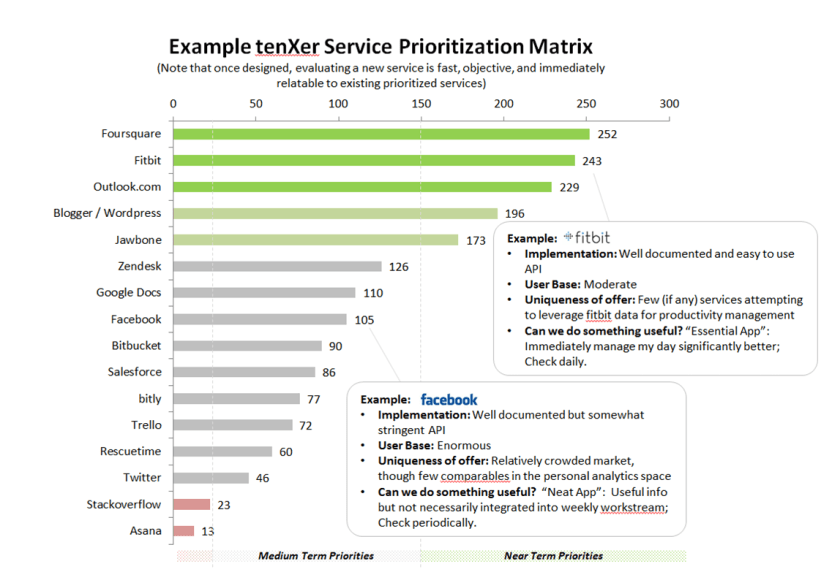
Another challenge we face at tenXer, is prioritization of the services that we connect to.  Currently we connect to services like Gmail, Calendar, Twitter, Jira, GitHub, Phabricator, and Pivotal Tracker. But how do we decide what service to connect to next? This is a difficult decision because there are a lot of criteria involved: How good is their API? How many users do they have? How unique is their offering? How valuable is their data? etc.  In order to make a more qualitative decision a bit more quantitative, we isolate these specific criteria and rate each on a scale of 1-5. While this is still somewhat of a subjective measure it helps us avoid favoritism toward a certain service.

Finally, the most important decision a startup has to make is around prioritization of features. With limited resources it is impossible to do everything, so understanding what features your customers really want is paramount. But sometimes that can be difficult, because asking a point blank question of your users can be very leading and can yield poor data.
So to solve this issue we leaned on technology. We sent out the typical Survey Monkey to our users where we asked them to prioritize different proposed features, but we also gave them open text fields to comment on things they liked and wanted to see in tenXer. We then used a proprietary sentiment analysis tool, developed primarily for use on Twitter, to identify different themes in their responses. Some common themes emerged, and fortunately those themes mimicked what we were seeing in their more structured survey responses. This gave us the confidence to move ahead on some specific product features.

While the decision to be data driven seems obvious enough, so does the notion of hitting a 16 against a dealer's seven. Yet many times both are ignored. And when this happens the player seldom wins.

Just how big is the mobile ad market going to be?

Posted 28 September 2012 15:29pm by Patricio Robles with 4 comments

Mobile is everywhere, and while it might not be everything, one need look no further than Facebook to recognize that for many companies, figuring mobile out is crucial.

But despite the obvious opportunities being created by the mobile explosion, many questions remain. One of the biggest: just how big is the mobile ad market going to be?

There are billions of mobile devices in use around the world, but even in the world's largest advertising market, the United States, spending on mobile ads is still in the single digit billions. Contrast that with spending on television ads in the U.S., which exceeds $130bn each year.

Many believe that the mobile ad market is in its infancy and that we haven't seen anything yet. Razorfish's Paul Gelb, for instance, has suggested that mobile ads will eventually overtake their television counterparts, and he's not alone.

Matt Cohler, a former Facebook executive who is now a partner at venture capital firm Benchmark Capital, also believes that "mobile will grab TV advertising's crown."

In a guest post on TechCrunch, he explains:

People are going to spend more time staring at mobile screens than television screens (and certainly more time than staring at computer screens, especially when you exclude work applications). Your smartphone is with you pretty much all the time. Smartphones are also inherently social devices, which explains the deep emotional connection people feel to them. The society-wide reach and social context that mobile smartphones will provide advertisers leaves other media in the dust.

Using a mobile device is also a focused, immersive experience. Like watching TV, the screen focuses the user's attention on one thing at a time and "changing the channel" is even less distracting than with a television.

So what is holding mobile ads back? According to Cohler, the current size of mobile ad market is "simply an issue of time and of product and market development."

Theory versus reality

Few doubt that the market for mobile advertising is going to grow significantly. But can it really overtake television, which still generates more than double the revenue produced by all web advertising?

Cohler's faith in mobile is based on his belief that mobile beats television in "frequency, reach and engagement." But does it? In practice, mobile advertising suffers from a number of challenges, including:

  • Size. One of the most attractive characteristics of mobile devices -- consumers always carry them because they fit in a pocket or purse -- is also one of mobile's most problematic characteristics. Put simply, creating effective mobile ads is a challenge with smaller form factors and even Apple
  • Efficacy. Mobile ads are often seen to deliver higher CTRs, but does that mean they're effective? In some cases, advertisers are learning that their higher-than-average CTRs are the result of fat fingers, not interest, something that's reflected in a lack of ROI.
  • The annoyance factor. Mobile devices are intimate devices. They connect us to our most important friends, family members and colleagues, and they are our lifelines when we need information in a hurry. While Cohler sees this as a benefit, it's actually arguably a limitation: mobiles are tricky devices through which to advertise because they give advertisers the ability to annoy at least opportune times.

    So it's not exactly surprising that many consumers seem to be tuning out mobile ads much as they do display ads. According to a new study conducted by Azullo, just a fifth of users polled could recall seeing an ad on their smartphone, either in an app or via the device's browser, within the past six months. Of the minority who did, over half couldn't recall the brand the ad was for.

  • Inventory glut. Advertisers pay hefty premiums for television ads and one of the reasons is that inventory is tightly controlled by networks and purposely sold in a fashion that limits the efficiency of the market. With mobile, there is effectively no limit to the amount of inventory that can be created, and much of that inventory is sold very efficiently. As such, it is likely that mobile ads will face the same downward pressure on price as their web counterparts.

Can these challenges be addressed? Yes, some more easily than others.

But there's no reason to believe that they'll be addressed sufficiently enough any time soon to produce the time of shift that would be required to propel mobile advertising to television-like heights. Advertisers and publishers still have a lot of work yet.

Q&A: Todd Crawford of Impact Radius on state of affiliate marketing

Posted 28 September 2012 16:11pm by Geno Prussakov with 1 comment

Todd CrawfordAs affiliate marketing matures, newer threats and challenges also evolve. However, the opportunities are still bountiful, and with the right approach a merchant can still succeed marketing their brand and business through a well-built affiliate program.

Today's guest is Todd Crawford, a recognizable affiliate marketing veteran, co-founder of Impact Radius, and former VP of sales and business development at Digital River's oneNetworkDirect.

In 1998 Todd also contributed to the founding team at Commission Junction, where he later served as Vice President for more than seven years.

What are the major challenges with which you see affiliate managers struggle?

Balancing time between revenue generating activities and administrative activities.  I think many people get bogged down with the day-to-day administrative tasks and don't focus enough energy on the revenue generating part of the job.  The key takeaway is creating as many efficiencies as possible to minimize the time required for day-to-day stuff so you free up more time to develop incremental revenue opportunities.

What do you view as the main affiliate program growth opportunities?

The affiliate channel is often kept separate from other media and ad distribution channels because of the performance pricing.  There's a significant opportunity to pull other distribution channels into the performance category because of the improvements in tracking and reporting. For example, a lot of companies offering distribution with mobile or through remarketing are willing to do so on a performance-basis. I think there's a lot of room for growth and expansion with media partners that historically were bucketed in the display or search channels.

In April 2012 an Illinois Circuit Court Judge ruled the affiliate nexus tax unconstitutional. However, more and more states are considering going the route of the "affiliate tax". Is there a good solution to this snowballing affiliate nexus tax situation?

The only real solution is a national Internet sales tax or some kind of tax that applies equally to all advertisers regardless of the media type that drove the conversion.

How can affiliate networks help merchants to continue working in the states with the affiliate nexus tax legislation?

I am not sure that affiliate networks or any other third-party can help solve nexus issues.  Technology cannot solve nexus issues.  The advertiser is responsible for interpreting and complying with any and all applicable tax laws.  It has been my experience that advertisers rely on their legal counsel or CFO for this advice. Beware of technologies that tell you they can solve nexus issues.

What about the "Do Not Track" legislation? Is affiliate marketing industry in danger here? And does Impact Radius have relevant solutions?

I am confident that privacy and marketing can co-exist peacefully.  Eventually, websites will not be able to generate revenue if consumers opt out of monetization of content.  I believe these sites will restrict access to visitors that do not wish to be tracked.  Consumers will have a choice - visit our site and allow us to make money or do not access our content.  In the end, I think most consumers will understand this  trade off  as fair and reasonable and doesn't compromise their personal information or security.

What are the top 3 things that affiliate managers (and merchants) should be looking at while choosing an affiliate network?

The first distinction I would like to make is that Impact Radius is a technology provider, not a network - this puts us in a unique position to help advertisers and agencies better manage their top relationships - from both a cost perspective and an incremental revenue perspective.  The first thing to look for when selecting any technology vendor is how will it solve your problems or allow you to meet your revenue objectives? When choosing a network, you need to know how the technology will support your needs and objectives. 

The second consideration is cost.  Networks typically charge a fee based on the success of your program - the bigger it gets, the more you pay.  If you or your agency are doing all the work of growing the program, does this pricing model make sense for your business?  The third consideration is do you even need a network to attract and manage partners? Most advertisers see 90%+ of their volume coming from a handful of top partners. These top partners are generally well known in the industry and easy to contact and recruit - especially if you are a medium to large brand.

Over the next 4 years Forrester predicts a steady growth for affiliate marketing. What are the top 3 areas of opportunity for affiliates these days?

  1. Content -- Developing unique content that attracts repeat visitors is the single most valuable asset any publisher can invest in.
  2. Mobile -- I believe in a few more years mobile will surpass online - so the sooner you get there, the sooner you will be successful.
  3. Media -- Utilizing more accurate and flexible tools to enable and measure more media channels to increase traffic to your site(s). Do not rely solely on search (paid or organic) for your livelihood.  Diversification into other media channels reduces your dependence on one channel for the majority of your traffic.  If you're not already testing social, retargeting, email, etc. - it's time to start!

If you were to leave affiliate managers with just one advice today, what would it be?

Communicate the value of your channel (and your contribution) to internal teams throughout the week, month, quarter and year.  Utilize every metric available to you to understand how your channel compares and interacts with other marketing efforts and educate your company on what you've learned.

Twitter, sports stars & freedom of speech

Twitter has landed a few sports stars in hot waterAt Branded3, pretty much everyone uses at least one social media platform of their choice.

Personally, I don't "like" Facebook, but since coming to Branded3, I have increasingly used Twitter both for work purposes (it's great for keeping an eye on Google updates and other industry news) but also for personal interests.

I follow a lot of sports stars, especially in golf, and Twitter is a great way to not only get up-to-date information on scores and news, but to actually interact with the players too.


Plenty of celebs have taken to Twitter to get closer to their fans and ultimately enhance their popularity and fame; but sports stars have really embraced Twitter more than most. For some sports stars media engagement is a breeze, but for most, they didn't get into the sport to receive the celebrity status and the endless media attention which comes with it.

For me, as an ex-competitive swimmer I don't think I could handle or deal with the fame and attention which has befallen some of swimming's biggest stars such as Rebecca Adlington and Ellie Simmonds; I was simply in the sport to swim and compete.

Luckily, there has been an improvement in the media relations training and support which sports stars now receive. For example, towards the end of my swimming career, lottery funding meant that me and my team mates could attend seminars and workshops on how to deal with the press, which really helped us understand what we should and shouldn't be saying , and how comment can be taken out of context.

But because Twitter is such a personal social platform, and a comment can be posted to the Twittersphere in a matter of seconds, it can sometimes land sports stars in hot water.

An example of this happening recently is Lewis Hamilton tweeting out some of McLaren's important telemetry data. He thought his followers would be interested in some of the technology behind the race, but his team and other teams thought perhaps he had leaked some secret data that could be used to gain those vital few tenths of seconds during the race.

Hamilton's Twitter Telemetry Data

In the end his team decided he had not given out anything that was too sensitive but if he had, perhaps another team could have won the Grand Prix that weekend. Despite the removal of the controversial tweet, by that time millions of people had seen and re-tweeted the comment, and the data was out there in the public domain forever.

Many players have lost jobs such as Northampton Saints hooker Brett Sharman for "inappropriate" tweets, which he would have put down to friendly "banter" that usually only stays in the dressing room between friends.

Kevin Pietersen also lost his England cap after a parody Twitter account was made about him, allegedly by some of his England team mates. Originally, it was claimed Kevin was holding up England talks due to his annoyance at this mickey-take, but in the end he was dropped from the team because of an "old fashioned" text message he sent to South African players badmouthing England and Andrew Strauss.

These examples show how important it is for public figures to watch what they're saying on Twitter, although they want to be themselves and let their fans get to know who they really are behind all the tabloid stories; there has to be a balance to what they're saying.

There are however some great sports people out there striking the right balance and enjoying interacting with their fans. Some notable embracer's of Twitter include Danny Cipriani who commented on the BBC:

"I enjoy interacting with them. You can say what you want and I'm pretty honest. A lot of young players ask questions and it's always nice to help them. You get some eggheads, but it's alright."

My advice to sports stars would be to stop and think about every tweet before posting it; if you're in doubt about whether you should be saying it, give it five minutes and phrase it in a different way or ask a social media expert.

When you're a top sports star, media attention isn't a choice; it's a given. It's a fine line to walk between being fun, engaging and controversial enough to create discussion; and sparking a media frenzy which calls for your career downfall!

My Top 10 Twitter Sports Stars

So, if you're looking for a few sports stars to follow on Twitter who create debate and give a great insight into the sporting world, then check out my recommendation below for the top 10 Twitter sports stars (in no particular order):

  • Ian Poulter – Good golfer, great Tweeter, with the Ryder cup starting today there could be some good action here.
  • Lewis Hamilton – Great pics of some of the cars he drives and you can see some of the F1 info (as mentioned above) if you are quick!
  • Joey Barton – Where does he get some of these quotes?
  • Michael Vaughan – Some great cricket commentary insights and a great Yorkshire man, perhaps avoid while he is on Strictly, however!
  • Andy Murray – Another prolific Twitter star with some good insights into the boring life of a tour tennis player.
  • Tony Hawk – Often tweets promotions such as the international Twitter hunt to find prizes near you.
  • Will Carling – Some genuinely insightful and funny tweets from "bum face".
  • Rio Ferdinand – Sometimes controversial but some interesting football tweets.
  • David "bumble" Lloyd – Need to find out what Beefy is eating in the Sky Sports cricket commentary box? Bumble will put his own spin on it.
  • Dan Walker – Not exactly a sports star, but some good insights from the BBC presenter.

I'm sure there are a few I've missed here so if there are any you think are worth a mention, how about adding them in the Facebook comment section below!

BY Matt Jackson AT 1:31pm ON Friday, 28 September 2012

With a background in analytical chemistry, Matthew has been analysing data for the last 10 years. As our Head of Strategy, his analytical skills have been helping Branded3 to understand data trends for the past two years. Some people may cringe at the thought of spending a day looking at Google analytics, but this for him is where it is at, there and on the golf course!

Pitching F2.0, Optical Image Stabilisation and 'faster, brighter' LED flash against Xenon

You see, the concept of better camera phone photos in "low light" keeps being cited and we saw yesterday in Engadget's tests, that Nokia's concept of full optical image stabilisation (OIS) in the Lumia 920 produces superbly clear photos when the subject stays still. So a boat or collection of test objects - or, indeed, a floodlit building. What's less clear is how well the Lumia 920 will perform when faced with real world photos of people - these, after all, constitute over 90% of most normal people's low light photos on their phones.

The thing about people is that they move. Even if told to stay still because you're taking a photo, they still move. Facial expressions change, they wobble (slightly) on their feet, hands and arms move (especially if holding drinks!), and so on. The trick is not only to light the scene, it's not only to make sure there's no blur from your own holding of the camera phone, it's to freeze the moment, too. And this is where my concern lies.

Now, don't get me wrong, I'm quite impressed by the static subject samples seen so far from the Lumia 920, but I wanted to apply a little maths to a comparison between it and phones like the Nokia N8 and 808 PureView, both armed with zero stabilisation, zero back side illumination, but a full Xenon flash. 

At the Lumia 920's launch, I noted:

  • a "floating lens" optical image stabilization system for "much sharper photography in low-light situations". 
  • a F2.0 aperture
  • BackSide Illuminated (BSI) 8.7 Megapixel sensor
  • an improved camera interface
  • the ability to record 1080p HD video
  • a "next generation short pulse high power" LED flash, rated at twice the brightness of Nokia's previous brightest LED unit and with shorter duration

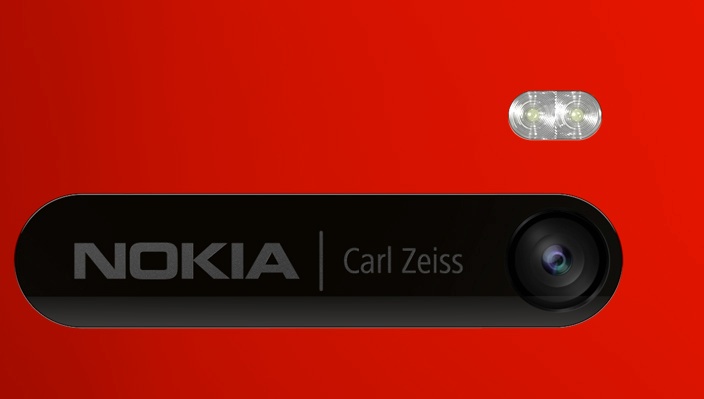
Lumia 920 camera

Leaving aside the not inconsiderable fact that the Nokia 808 and N8 have much larger sensors (and can thus process more detail and/or do so with lower digital noise), let's start with the usual rule of thumb that a phone-mounted Xenon flash is roughly ten times brighter than a standard LED arrangement but with a duration that's a hundred times shorter (which is why Xenon flash can freeze the moment).

Now, let's add in a few correcting factors. The larger aperture in the Lumia 920 (and other top 2012 camera phones like the HTC 8X) means that more light can be acquired in a short time period, so let's call this a factor of two better than a 2010 camera-equipped phone. The BSI sensor processes light more efficiently too, let's be generous and assign this another factor of two improvement. The Lumia 920's was specifically quoted as being twice the brightness of previous Nokia LED flashes, so that's a further factor of two. I'm tempted to assign another factor for the 'shorter duration', but a) we've been generous so far and b) I suspect that it's not more than a few percent shorter.

Overall though, the three factors of two ('2' cubed is eight, for the maths-challenged out there!) bring the illumination factor for the flash in the Lumia 920 up to the same order of magnitude as the Xenon flash in devices like the Nokia N8 and Nokia 808. This is an important levelling achievement.

However, the flash duration is still an issue. As I say, a few years ago, my own tests (e.g. the frozen [spinning] fan blade here) and calculations showed that Xenon was a hundred times faster than LED flash, of the order of 100 microseconds. No matter what you're trying to photograph in low light, be it people or kids or animals, there's little any of them can do in 100 microseconds to spoil your shot. I've tested the Xenon flash on various Nokia camera phones (N82, N8) and successfully frozen the pounding arms of band drummers, and of kids jumping in mid-air, in near total darkness. When trying to photograph friends and family indoors and at evening events, such flash heroics are more than sufficient to freeze the moment.

Now, the (roughly) eight fold improvement in light acquisition for devices like the Lumia 920 means that, for close-up subjects at least, the exposure can be reduced by a similar amount, i.e. there's (potentially) eight times less motion blur in your peskily moving subjects. Add that into the removal of motion blur caused by you moving the phone (because of OIS) and there's every likelihood that social photos taken on the Nokia Lumia 920 will be quite a bit better than in the previous generations of phone camera with LED flash.

The mathematician in me will still point to the fact that 100 is still roughly twelve times greater than 8, though - so Xenon-lit shots from the likes of the N8 and 808 will still be an order of magnitude sharper again.

I've done lots of Xenon rants over the years on AAS, but here's a typical example of the sort of thing Xenon flash can achieve in your life, courtesy of Jay's Halloween photo set from his Nokia N8:

Typical party shot, from a Xenon-equipped Nokia N8

Leaving aside the obvious question of how come we never get invited to this sort of party(!), the huge question is whether the likes of the Nokia Lumia 920 can get anywhere close to this level of quality/sharpness?

It was noticeable that in Myriam's tests yesterday, Nokia only encouraged here to snap static subjects. There were a few done of people under the same circumstances, for example this one, taken on another Lumia 920 of (a very well wrapped up!) Myriam taking test shots on the other 920:


I'd argue that, although reasonably exposed, details of face and hands have the typical blur of non-Xenon-lit camera phone shots. The Lumia 920's flash was turned off, but I don't think that would have made much difference in terms of failing to 'freeze' the moment.

Now, obviously, we're only talking about Lumia 920 prototypes here and I've never even held the device, but I think I can be fairly confident in stating that, while the Lumia 920 will produce stunningly good night photos of static subjects, it will, even with the improved LED flash, still not be able to get close to the frozen quality of photos under identical conditions from the 2007 Nokia N82, the 2009 Sony Ericsson Satio, the 2010 Nokia N8 and the 2012 Nokia 808 PureView.

The other obvious question is why do more manufacturers not put Xenon flash into their phones? The Lumia 920 is easily thick enough for the required (300V!) Xenon capacitor, though I'd agree that thinner phones like the HTC 8X might have an issue. The other reasons usually quoted are battery drain (each Xenon shot can draw as much as five or ten times the power as an LED equivalent) and the way Xenon can't double as a torch or video light.

I remain frustrated though - the only Windows Phone device to have 'Xenon' flash was the HTC 7 Mozart - and it was so badly implemented that it produced worse results than my LED-powered phones back in 2005. The only Android phone with Xenon was the Motorola Milestone XT720 and that was utterly crippled by being slower than a Nokia N97 covered in treacle.

So I return to my opening statement. I'll head out to any low light social event of Nokia's choosing  - and I'll bring the 2007 Nokia N82. The Lumia 920 folk can bring along their 2012 prototypes and we'll shoot a load of shots around a few drinks, chat and general cavorting. And I bet the N82 nails 90% of the best photos.

In the meantime, you'll find me geekily sulking over my pint in the corner of the pub, cradling my N82, N8 and 808......

Cute Images Make Us 44% Sharper [STUDY]

Super Cute Dog by Lance Ulanoff

In the best news yet for viral cat videos and pictures of babies hugging puppies, researchers at Japan's Hiroshima University found that people actually focus better shortly after they've been shown "cute" images.

Researchers performed three experiments where they showed subjects a variety of images that included food, people, and adult and baby animals.

In a fine-motor dexterity test, 48 subjects (all between the ages of 18-and 22 and all right handed) played a children's game very much akin to "Operation." For those unfamiliar with the game, you use tweezers to remove plastic body parts from metal-encased "cavities" without touching the edges and setting off a buzzer.

Subjects played the games multiple times and, before at least one session, researchers showed them images of puppies and kittens.

Those images, according to the study, helped them play the game 44% better. Full grown dog and cat images also had a positive effect on performance, but not by as wide a margin: just 5%.

Cute images, however, may not only effect motor abilities, but have a positive cognitive effect, as well.

In another experiment, a new group of 18-to-20 year olds performed a series of visual search tasks where they had to identify text and numbers in images and images comprised of text and numbers. They, too, were shown cute images in between tasks. The results weren't as dramatic, but their ability to properly identify the images did improve by 2%.

Now before you spend the rest of the day staring at pictures of babies tickling puppies, keep in mind that all of these results had a plus or minus deviation of up to 10%.

That did not deter the Japanese researchers who say in their report: "For future applications, cute objects may be used as an emotion elicitor to induce careful behavioral tendencies in specific situations, such as driving and office work."

So, what do you say? Let's all try own little experiment Try driving, surgery (only if you're a doctor), archery, target shooting, threading a needle…you get the idea…then look through this adorable gallery and do it all again.

Let us know in the comments how you performed.

Start Me Up! A profile of Rare Crowds

Posted 28 September 2012 14:01pm by Graham Charlton with 0 comments

Rare Crowds is a startup which aims to help publishers and ad networks get more value for their ad inventory by creating a new type of premium inventory. 

I've been asking CEO and Founder Eric Picard about the business model and his immediate and long term goals for the company...

In one sentence, what is Rare Crowds?

Rare Crowds helps Publishers and Ad Networks sell their existing ad inventory for more money by creating a new extremely targeted type of premium inventory on Owned & Operated sites, as well as doing inventory procurement on ad exchanges.

What problems does Rare Crowds solve?

Despite discussions about "infinite supplies" of ad inventory in Display, Mobile, Video and Social. Publishers suffer from an extreme shortage of premium inventory.

Rare Crowds creates a new bucket of premium inventory from their existing inventory pool, enabling them to sell more inventory that advertisers actually want, at higher prices than run-of-network inventory with a few targeting parameters.

We also enable both publishers and ad networks to procure extremely targeted premium inventory on ad exchanges, and re-sell it to their customers.  This is effectively high-scale premium inventory for RTB and Ad Exchanges. 

When and why did you launch it?

We founded the company in March of 2012, we officially launched at TechCrunch Disrupt in San Francisco on September 10th, 2012. 

Our mission is quite literally to save media as it moves from traditional distribution to digital distribution.  Economic value of advertising decreases by nearly 100% from traditional distribution channels to online.  

Our goal is to provide media companies with highly profitable advertising monetization vehicles that can help them not only survive the transition to digital – but can preserve or even improve the economics of traditional media.

Our first product is a highly differentiated premium advertising inventory type (the "rare crowd") that is simply not available in traditional media. It is highly scalable, and assembled to be an exact match against the explicit campaign goals of an advertiser – all the way to persona-level audiences.  

Because we take both audience and media attributes into account, we work very well for premium publishers such as those making the transition between offline distribution and online distribution. 

How are you funding the company?

We are in the process of closing out our seed round of funding through angel investors and seed stage venture funds.

Our initial investors include Rich LeFurgy, founding chairman of the IAB and Managing Partner of Archer Advisors; Tom Shields, founder of Yieldex and previously founding CTO of NetGravity (sold to DoubleClick) and managing partner at the Woodside Fund VC; Nick Pahade, North American CEO of Initiative Media (an IPG company); Mike Toutonghi, CTO at Parallels and previously a Microsoft Technical Fellow who started the .NET team and was the chief architect of Microsoft's advertising platforms; as well as several other industry luminaries who have asked not to be named publicly.

Recently we began to raise our second tranche of funding for seed. The initial was to get through technical proof of the technology working as expected (Beta went from February through July).  

The next phase of seed funding is to complete our initial go-to-market with Publishers and Ad Networks (Customer Validation) and we expect to be through this in the next quarter or so.  

We just added our first new investor in this phase, Dirk Freytag, who is currently the General Manager of Germany at The Rubicon Project, but previously was CEO of ADTECH (Sold to AOL). We're in discussions with many other investors and expect to add some new ones soon.

We'll be going out for a Series A round of funding in the late Fall or early Spring from venture firms.

Who is your target audience?

Our target customers are large publishers, ad networks and Supply-Side Platforms (SSPs). We also partner with ad exchanges, DSPs, and data companies.  

Our AppNexus App should go live in the next month or two, and will enable AppNexus account holders to procure inventory across the exchange – whether trading desks, ad networks, publishers, or media buyers.

What are your immediate goals?

We are going live with significant customers now, so our primary goal is to smoothly implement our technology with our customers, as well as to sign up additional customers.  And of course, to raise more funds.

What were the biggest challenges involved in building Rare Crowds?

The technical challenge we're solving is extremely difficult, so inventing this technology was not simple. But figuring out the human factors have been equally difficult. Our product does some extremely complex things and making the user interface and various processes simple was a big challenge.

But in the end, we've created an inventory packaging system that completes an RFP response in  10 to 20 minutes, is fully integrated into DFP and other ad platforms, and only has one primary negotiation element – average CPM – between the seller and buyer. 

How will the company make money?

We get paid a percentage of media spend on the packages we create. Obviously the price varies by the amount of revenue a partner brings to the table.

Who is in the team and what does it look like?

I'm the CEO, and I've been in the Ad Technology space my whole career. I founded Bluestreak, one of the first ad tech companies back in 1997. I went to Microsoft in 2004 and spent six years there leading ad technology strategy across a few different teams.

I was deeply involved in the ad technology acquisitions we did from 2005 to 2007, and then the Yahoo-Bing Search and Advertising partnership deal team. I also did significant research into advertising economics and incubated numerous projects with engineering teams.

My CTO and co-founder Scott Tomlin is a 14 year Microsoft veteran who has spent ten years of his career on ad technology. He was development manager on display advertising platforms and then on adCenter.  

He's an amazing partner, architect, technology leader, software developer, and business partner! 

The remainder of the team is engineers right now, all former Microsoft, Google, TRAFFIQ and Bluestreak engineers with many years of ad tech experience. 

Where would you like to be in one, three and five year's time?

In one year I'd like to have successfully gone to market with our first product, and be ready to begin go-to-market on our second product.

In three years I'd like to have at least forty customers ranging across large publishers, ad networks with full adoption of our first product, and about 25% adoption of our second product.  I'm confident we'll have other products to create and launch as well.

Five year horizons in this industry are challenging, but to be bold: In five years I'd like to toast the successful IPO of the company from Moon Base Alpha...

And yes, we already have a good idea of what our second product will be.