martes, 28 de febrero de 2012

The false comforts of fractional attribution

Posted 27 February 2012 15:01pm by Robin Davies with 1 comment

Back in 2008 I thought fractional attribution was a complete solution but after the last four years working with brands, my opinion has changed.

I have discovered that while this method is not entirely without merit, it is disappointingly limited and doesn't do much to help a marketer re-allocate spend meaningfully.

In 2008 Microsoft said 'the company can now provide a scientifically based standard showing how well different media affect an eventual conversion', this was engagement mapping, a classic example of fractional attribution and what have we learnt from it? 

My take on it is that user interface sliders and shiny bubble graphs are sexy but technology has to do more than look good, it must synthesise, it can't just echo back what you tell it.

It's important to try and learn about the successes and failures of your marketing spend, this is how we build successful programmes. Attribution analysis should enable you to examine the empirical value of your media and reallocate your spend accordingly.

Here we are, four years on from engagement mapping and most technology suppliers have still not developed any meaningful alternative to attributing returns to media investment on a last-in basis. 

In my opinion, at the centre of this problem we are plagued by two facts:

Correlation is not the same as causation

A can be correlated to B but that doesn't necessarily mean A caused B. 

Take for example the tight relationship between shark attacks and ice-cream sales, however we all realise that we can't save lives by banning ice-cream sales because the one is not causing the other even though the two appear to be co-related.

We all want to know which elements of our media investments are causing sales so we can re-allocate spend into those elements and cause more sales. 

Simples! Except it's not that easy!

Return On Advertising Spend (ROAS) can only really be considered at the level of the entire budget. 

The moment we consider a subset of the total media spend such as investments in digital sub-channels like search, social and display, we need to address the attribution of sales revenue correlated to these sub-channel media investments. 

Suddenly we are now talking about degrees of assumed causality, how much of your reattributed spend are you going to allocate to each sub-channel? 

This is where our industry has willingly ignored the true challenge/opportunity of attribution. What has happened is that to simplify matters, the industry has favoured a dumbed-down approach in which the degree of assumed causality is fractioned out according to the marketer's arbitrary reckoning.

Typically we see equal share across these digital sub-channels, a model sometimes referred to as "flat attribution". What's even worse is that some agencies/vendors would have the capacity to up-weight elements of the media plan that make them more margin.

So what is the true opportunity here? We are talking ourselves out of the last click standard, so what could replace it?

We may be comfortable with the idea that a physical action, like a click, is a more qualified engagement compared to a display impression but strictly speaking we can no more claim causation from a correlated click as we can from a correlated impression.

The good news is that identifying media effectiveness is not like proving innocence or guilt in a court of law. 

It's OK to let some clicks go that were actually responsible for sales and lock up some clicks in media plans that were caught up in circumstantial evidence and which had nothing to do with developing purchase intent - nothing unjust is going to happen, we're looking for marginal improvements in performance not proof cases.

What I recommend is working with proven statistical models. The statistical approach identifies highly correlated media events, not just all correlated events and most importantly it synthesises a degree of correlation.

By isolating single variables such as creative, placement or retargeting context while controlling all other variables (in so far as possible) it can yield statistically significant indicators of incremental media value. 

This provides the confidence in the assumption that there was causation effect (remember, you can't get away from the fact that this will always be an assumption). 

Here are three key takeaways for considering an approach to your attribution strategy:

  • Fractional re-attribution can provide insights but don't be afraid to question a vendor that offers this as their only solution. How much use is a report that echoes back what you told it?
     
  • Statistical modelling takes into account media that didn't correlate to sales meaning you also take into account media investments that didn't result in sales.  Best not to ignore the media that didn't convert as it's likely the bulk of your media spend.
     
  • Statistical modelling can provide an actual number that quantifies the contributing effect of elements in your media plan so you can confidently reallocate spend. Proper statistical analysis ensures these actual numbers are only drawn from statistically significant sample sizes.

This is mathematical marketing: let's use methods of which our GCSE maths teachers would approve.

How Startups Can Build Lasting Relationships With Journalists

Dmitry Dragilev is the marketing lead at ZURB, the interaction design firm behind ZURBapps, a suite of apps that helps people quickly design great products through rapid prototyping, iteration and user feedback.

It's a week before launch and you're hoping to score some awesome traffic from a well-known publication. Here is what usually happens: You send a PR release to a bunch of publications, you pay big bucks for PR agency representation, you tweet the day of the launch, and you hope your story gets picked up.

Be honest — how well did this approach work for you the last time you tried it? Lots of effort, but my guess is you were probably disappointed with the return.

Instead, approach reporter interactions as you would an actual relationship.


1. Date Before You Pitch


Most of us decide to pitch journalists right before a product launch launch or announcement, shooting out a press release and hoping to score great articles. This is the worst thing you can do. Don't expect to pitch someone who doesn't know you or your product, in the hopes that person will understand the story and details just right — all in a few days.

Instead, build a strong relationship that benefits both of you — it's the only way you can ensure great news coverage of your product launch.

After all, you don't pitch a VC or angel investor cold, expecting to earn funding, right? These days, you don't apply to a job cold and expect to get hired. As you know, relationships are everything when you are trying to build a company. A strong relationship with the press is just as important as maintaining relationships with your investors. Before you can even pitch to a reporter, you'll have to spend months of hard work, maybe even years, building a strong relationship.

Here are some specific tips on how to build genuine relationships with journalists.


2. Courting


First, you need to have a good idea of who your paying customers might be, where they tend to gather on the web. Which news publications/blogs do they read? Look at the comments on articles and figure out which publications you want to target.

Once you determine the correct reporters/publications, build a relationship with reporters almost exactly like you would build a relationship with a potential spouse. Research what catches the reporter's eye, both personally and professionally. Have at least three points you want to genuinely talk about, none of which relate to your product. Reach out and give the reporter something first (e.g. send in a story tip, for instance) before asking him for anything. Remember, you aren't looking for a "one night stand;" you are courting for a long-term relationship.


3. Dating


This isn't an "adult" friend finder service; this is eHarmony. Develop your reporter relationship over months: Help him out and show your interest in his beat. Show how the reporter can benefit from your help: Bump a reporter's stories to the top of Techmeme, tip him off about breaking news, talk to him about his articles, respond to his questions in articles and via social media.


4. Getting Serious


You've already built a solid and genuine relationship with your reporter. By the time you ask for coverage, you should have helped him out a number of times. You've initiated multiple discussions that cover a variety of topics. You'd be comfortable meeting up and grabbing a drink with your reporter.

From here on out, you need to be extra careful. Around the time you're attempting to seal the deal, your actions are critical to achieving awesome results.


5. The Actual Pitch


By now, you can determine your reporter's interests and beats. Your pitch should be connected with at least two articles the reporter has written. If it doesn't, you're pitching the wrong person.

Your story must have a hook; in other words, it must relate to current trends or events. Most bloggers and news sites won't be interested in a product that's off-trend.

Stay super simple. Practice your pitch and wording before you talk to people. Think of it this way: Would your grandmother be able to understand what you're taking about? Remember, you're competing with a million other things that might grab a reporter's attention. If you aren't crystal clear, a reporter can get distracted or bored with what you are saying. Connect your product to trends and show how it stands out from others in this area.

You should be able to pause after the first sentence of your pitch, confident that the reporter already partly understands what you're talking about. It's good if the reporter asks a question back. If you receive a confused response (or none at all), you probably need to make it simpler.

Here are a few sample pitch sentences we used when launching our app.

  • App X helps you see if ads are getting in the way or if content isn't getting read.
  • App X is a another tool to supplement surveys, feedback forms and chat.
  • App X can help you test landing page performance — it's a guerrilla marketing tool.
  • App X helps you determine if your brand is headed in the right direction.

6. Ongoing Relationship


Your relationship with a reporter or blogger doesn't end after the pitch. You want it to be in it long-term, like a marriage. Like a real spouse, you'll have to invest in the marriage, maintaining it over time. After all, you've spent months and months courting this reporter — you don't want to toss him aside once the story is published. Keep the lines of communication open, and you won't be without a date the next time you launch a product.

Image courtesy of iStockphoto, wellphoto, Flickr, thinkpanama

Top 10 takeaways from SES London 2012

Posted 27 February 2012 10:56am by Heledd Jones with 1 comment

Last week saw the annual SES (Search Engine Strategies) conference in 2012 where all the big names in search gave their view on the year ahead.

The overarching hot topics were probably Google + and SoLoMo (Social, Local, Mobile).

There are some good round-ups to be found online (e.g. Andrew Girdwood's blog and Kevin Gibbon's blog) so for now, here's my (and my colleague Richard Lewis') top 10 take-aways for you to think about.

(Apologies in advance if I haven't given the right people the right credit, feel free to comment if I missed you off the list.)

1. Test new targeting options in Facebook

The launch of 'timeline' has created some new targeting options to test in Facebook advertising  e.g. you can target mobile users, and people that have 'just moved' and/or are 'expecting parents', really useful if these are life-stages that you're trying to target. (Courtesy of Efficient Frontier's Jonathan Beeston).

2. 'Beat the burn' on Facebook ads

Jonathan Beeston also talked about burn-out on Facebook ads and argued that the key driver of CTR is the image:

  • By all means refine the copy and headlines, but the big wins are to be found in testing images.
  • Company logos typically don't perform as well as real, human images.
  • Keep refreshing the images as they 'burn out'.
  • Also consider using scheduling and budget caps to cap exposure and stop the 'burn-out'.

3. Improve your site stickiness

Great presentation from Jeff Slipko (Expedia) to remind us that stickiness isn't just about time-on-site, it's about getting people through your conversion funnel so look at your site to ensure that you're:

  • Instilling benefits. These will encourage customers to come back to you if they aren't going to convert straight away (e.g.do you have testimonials and reviews on-site? Are you dissuading any security concerns?).
  • Creating urgency, If you're selling something then can you test  'only x items left' or 'x amount of users are viewing this deal' or 'price guaranteed until x'.
  • Testing. Expedia increased conversion by testing everything from the font size of the price to the use of filters (display x prices) etc.
  • Streamlining the checkout. Is there anything unnecessary that can be removed at the purchase point? Remind people what they're buying. Display a phone number if that helps conversion.

4. Are you making the most of your existing relationships for SEO link building?

Get case studies from your agencies to get links back to your site, ditto universities that have relationships with your business. (Courtesy of Verve Search's Lisa Myers).

5. Optimising for SoLoMo (Social Local Mobile)

There were some great talks about the use of SoLoMo and tips like:

  • If customers are 'checking-in' to your competitors' outlets, track this (e.g. via Tweetdeck) and tweet them to offer a discount to use your company instead.
  • Reviews are vital for ranking in Google local – so incentivise reviews e.g. through the use of prize draws (and add these to your site mark-up).
  • Add Google analytics' tracking URLs to the content you promote in Twitter, so you can track this traffic in Google analytics (otherwise it goes into the 'direct traffic' pot).

6. How can your company use Pinterest?  

Another hot, new trend that was discussed at several sessions. Does your brand have a profile yet? If not, worth a test and an easy one for retailers. For non-retailers, think about how you can utilise it so that it ties back in with your brand?

7. YouTube keyword tool

Did you know that YouTube has its' own keyword tool, based on what people search for in YouTube?

Could be useful for:

  • Planning which videos you should create as part of your content strategy.
  • Planning keywords to optimise for in your PPC/SEO campaigns.

8. Investigate free tools

If you don't have the resources, use sites such as http://cannedbanners.com/ to create professional looking banners that you can add into Google's Display Network as part of your Adwords activity.

9. Copywriting creates sales  

Don't forget the importance of good copy when optimising landing pages (there was talk of a tendency to focus on images, buttons, etc, only) @optimiseordie from Belron attributes 50-70% of uplift in optimisation tests to copy (including call to action wording, title, headline, strapline and framing).

If you don't have an in-house copywriter, he argued that it was worth investing in a specialist agency.

10.  And finally, with all the talk about Google+:

  • Does your company have a Google+ page?
  • Use your page to promote your content, and grow your circles by asking customers to add you to their circles (and by adding relevant people/brands to your circles).
  • Use Google's new rel:author functionality to spread your content wider and drive more Google traffic to your site, as it makes your content stand out (and could become a ranking factor).

At the moment, most Google+ users seem to be in the digital marketing industry, but if you can dedicate some resource to this you might reap some benefits ahead of your competitors if and when it does take off in the public domain.

Do digital leaders need both client-side and agency-side experience?

Posted 27 February 2012 10:30am by Andrew Warren-Payne with 1 comment

In our digital marketing and e-commerce careers guide, published at the beginning of the month, we put together some of the industry's best advice on how senior digital professionals can improve their career.

As so much great advice was contributed that we couldn't include in the report itself, we've been publishing blog posts featuring the commentary we received.

Last week we asked whether it was better to be a generalist or specialist in digital marketing, and the week beforehand we asked what attributes were most sought after in senior digital professionals. 

This week our contributors answer the question: do digital leaders need both client-side and agency-side experience?

Though the answer may appear obvious for some, this question provoked a variety of responses with some interesting points on the merits of having such a background. We've compiled some of the most valuable insights below.

Rosalie Kurton, head of new business, LBi:

Not necessarily. It helps to be able to understand a client's challenges operationally, as well as from a marketing and technology viewpoint, but this is often the result of forging strong partnerships and relationships with clients, including periods of co-location to create a blended client/agency team."

Claire Higgins, head of digital marketing, Selfridges:

I think having both is an advantage, as well as having a variety of experience across different sectors.

The benefits range from the consultative approach and strategic insight that an agency background can bring to the table, to understanding the pressurised dynamic of agency life that can help the team perform well under tight deadlines."

David Paice, e-commerce director, Merlin Entertainments:

If you can speak an agency's language it will generally help speed certain processes up and you will have a better appreciation of whether you are getting value for money, but this is not essential."

Chris Ketley, head of digital and e-commerce, Bupa:

No, but I have, and it helps in two ways from a client perspective: first, to appreciate how an agency might add value and also its limitations; second, because in many companies the digital function operates and acts like a central agency resource. Business capability assessment, internal specialist digital skills and relationship management and are all important elements shared by clients and agencies."

Allison Wightman, head of ebusiness, Virgin Atlantic:

Not necessarily. Both client side and agency side are exciting jobs but it's often considered much cooler to work in an agency with different accounts, varying projects and new opportunities, particularly when you are getting a grounding in all things digital. If you work for a brand you have the challenge of growing a profitable digital business and also enjoy the perks of whatever company you work for, but you may not stay put as long as to grow in your career, as there is often only one website in most companies."

Matt Simpson, head of digital for EMEA, OmnicomMediaGroup:

Absolutely not, although it has some advantages. The benefit of having a background which includes both client and agency experience is a generally better understanding of what people want out of a situation, a better ability to read between the lines. There are many issues which affect a client's ability to implement certain recommendations which are often not explained, having some knowledge of these is of course very helpful."

Alison Lancaster, CMO, Kiddicare, and marketing director, Morrison's Non-Food:

I'd say yes, because I do - and you get very different perspectives depending on which side of the fence you're sitting. Having worked on the agency and consulting side, and then become a client, I think you are able to get closer to the commercial priorities, trading issues, available data and wider business needs.

However, when the chemistry is right, great agencies really listen and invest the time to get to know their clients inside out as if they are part of the client team. Great clients really appreciate and understand how to get the most out of their agencies - sharing information and insights as if they were an extension of their own team, and knowing what motivates them.  So if you don't have experience on both sides, take the time and trouble to really engage, listen, question and view things from both dimensions - and, of course, always view from the customer perspective."

Tessa Cook, e-commerce MD, Dyson:

No, not at all. Agency side people are often great at prioritising, project management and strategy. Client side people tend to be more grounded in reality, and great at getting stuff done."

Paul Wishman, group e-commerce director, LV:

This isn't mandatory, as experience gained is usually sufficient to understand how to manage and work with respective agencies. This said there is value in having someone who is able to better empathise when dealing with their agency counterparts, and often people with this background do have greater technical depth."   

Russell Gould, former MD, e-StrategyConsultancy.com:

This is nice to have but I don't really see any great value here. The key is to understand both sides."

Fiona Spooner, head of acquisition and optimisation, Financial Times:

I'm sure it's helpful but not necessary. I would say that though as I have always been client-side, but I make a point to spend constructive time with agencies, learning how they work and think."  

What are your thoughts? Do you need both client-side and agency-side experience to succeed in digital marketing? How useful is it to have? Have you made the transition from one side to the other?  Join the debate and share your thoughts in the comments below.

For further information, download our free digital marketing and e-commerce careers guide (registration required) or find out more about the other free reports offered by Econsultancy. 

Andrew Warren-Payne is a Research Analyst at Econsultancy. 

Nokia 808 PureView announced, dramatically extends world camera phone leadership

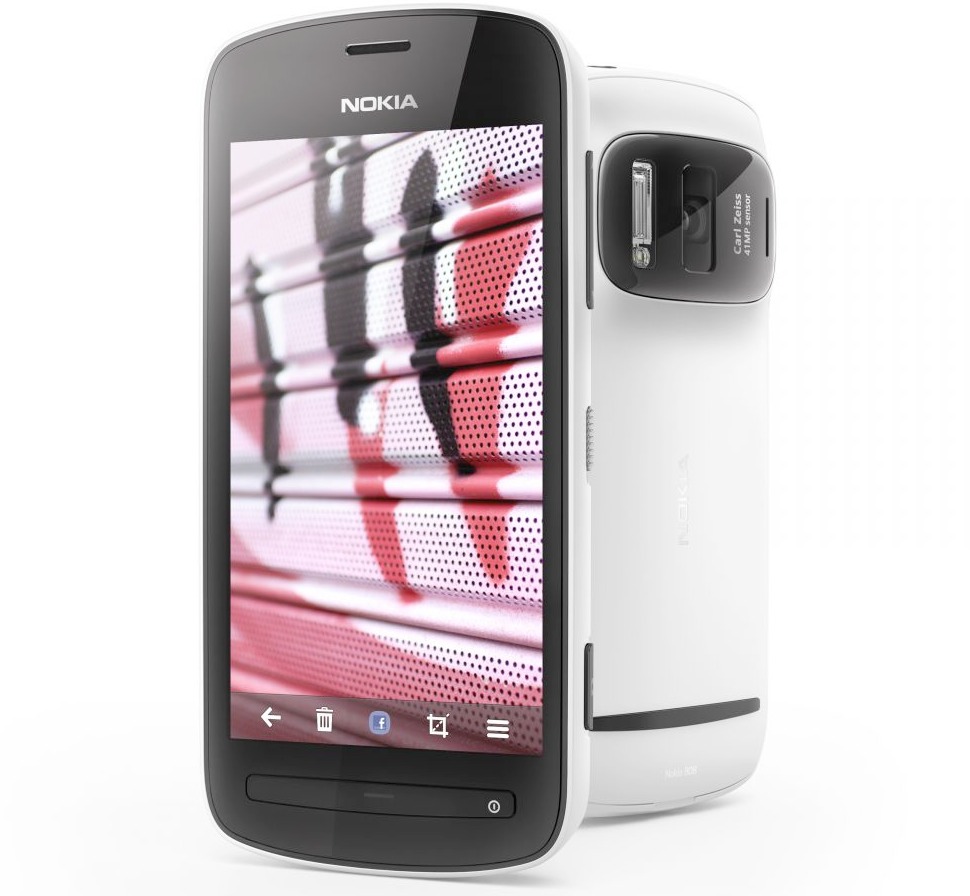
Nokia 808 PureView

From the official press release:

The Nokia 808 PureView features a large, high-resolution 41 megapixel sensor with high-performance Carl Zeiss optics and new pixel oversampling technology.  At standard resolutions (2/3, 5 and 8 megapixels) this means the ability to zoom without loss of clarity and capture seven pixels of information, condensing into one pixel for the sharpest images imaginable.  At high-resolution (38 megapixel maximum) it means the ability to capture an image, then zoom, reframe, crop and resize afterwards to expose previously unseen levels of details. With superior low-light performance and the ability to save in compact file sizes for sharing in email, MMS, and on social networks, the Nokia 808 PureView makes it possible for anyone to capture professional looking images in any conditions.
In addition to superior still imaging technology, the Nokia 808 PureView also includes full HD 1080p video recording and playback with 4X lossless zoom and the world's first use of Nokia Rich Recording.  Rich Recording enables audio recording at CD-like levels of quality, previously only possible with external microphones. The Nokia 808 PureView also features exclusive Dolby Headphone technology, transforming stereo content into a personal surround sound experience over any headphones and Dolby Digital Plus for 5.1 channel surround sound playback.

The 808 PureView is a 4"-screened (CBD) Symbian/Nokia Belle smartphone, running "Belle Feature Pack 1" (improved performance, personalisation and entertainment options, with a new browser, the latest Nokia Maps and an improved notifications bar), running at 1.3GHz with GPU and 512MB of RAM. We've listed the full specifications at the bottom of this story.

The phone will ship in 3 colors at the start – Black, White and Red - and should cost around 450 Euros before taxes and subsidies. The 808 PureView is expected to be available in the 2nd Quarter of 2012.

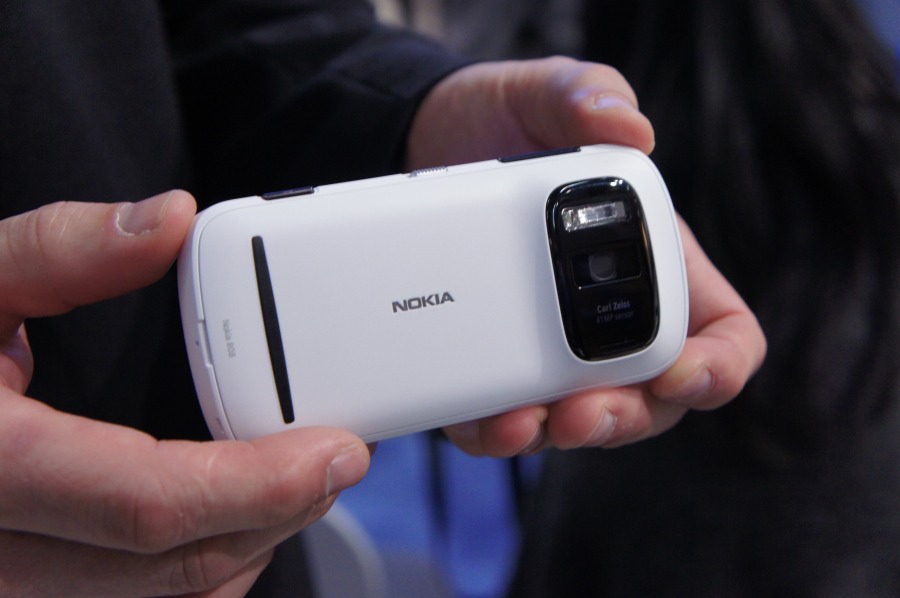
Here's the 808 on display today at MWC:

808 on display 

Camera phone leadership and innovations

Whatever else is levelled at Nokia these days (and it has had its ups and downs, to be sure), even its harshest critics have acknowledged that it has been at the forefront of camera phone technology for the last decade. Heck, Nokia invented the term 'camera phone' with the launch of the 7650, back in 2002. Ten years later we arrive at the 808 PureView, via the N70 (fixed focus, first 2 megapixel in a smartphone), N93 (first 3 megapixel, first VGA capture, plus optical zoom), N95 (first 5 megapixel), N82 (first with Xenon flash), N86 (first to have a 1/2.3" sensor, first with 8 megapixel, first with intelligent digital zoom, first with full digital microphone), and, of course, the N8 (first to have a 1/1.83" sensor, plus capturing 720p video, and with Xenon and most of the other tech from the N86).

That's quite a legacy and you'll therefore excuse Symbian-powered camera phone fans for going just a little bit crazy with today's news. 

Why not optical zoom?

One thing that never made it into Nokia camera phones (other than the barrel-camera N93/N93i) is optical zoom, chiefly because, even back in the days of the N95, the physical mechanisms needed were deemed too bulky. Fast forward to today, with even more of an awareness of device thickness, and it's easy to see why Nokia opted for a little lateral thinking in providing a solution to one of the biggest issues with camera phones - uninformed users using the supplied digital zoom without realising that they're actually losing detail rather than gaining it. 

In video capture, in the N86 and N8, Nokia's intelligent digital zoom has the spare resolution to allow up to 3x effective zooming without losing any quality whatsoever, and the next logical step has been to implement something similar in stills mode (and retain it for video, as well, as you saw above). But the N8's 12 megapixel sensor was already being used fully - so where next? The answer was to radically increase the number of pixels further - not (necessarily) to provide the user with unwieldy and unnecessary 40 megapixel photos but to interpolate from this vast pixel array at any zoom level and resolution needed.

The 1/1.2" sensor 

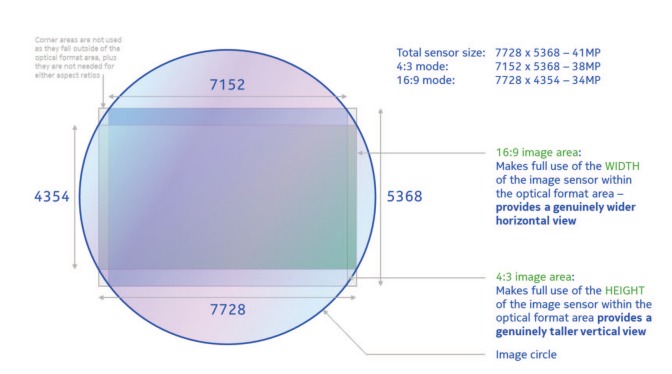
The 808 PureView's sensor is huge - 1/1.2" optical format, a full 2.5 times the size of the N8's sensor, which was already by far the biggest in the smartphone world. In terms of pure physics, the 808 PureView is as far away from the N8 in terms of performance as the N8 was to its competition back when it launched in 2010. Here's a look at how the 41 megapixel sensor is laid out:


(taken from the PureView white paper, well worth a perusal)

Below is the brief demo video showing how the pixel oversampling works, essentially combining information from seven or so sensor pixels to provide higher quality detection of accurate colours to one virtual pixel. In addition to better colour accuracy, there's dramatically better lower-light performance too, since a lot of the digital sensor 'noise' can be averaged out.

And, whereas traditional optical zoom mechanisms and lens assemblies cut down on the amount of light available to the sensor, the pixel oversampling technique works with a fully open lens and aperture meaning that as much light as possible is gathered. Again leading to lower noise in your photos, even when you look really, really closely.

In practice this means that the 808 can achieve dramatically higher image quality than any phone camera on the market and, indeed, many standalone cameras, while offering up to three times pseudo-optical zoom (24-74mm), without losing any detail through conventional digital zoom methods.

Below is an example Nokia 808 image, taken in low light conditions. And here's the full 38 megapixel version for your perusal! (via Nokia Press)

Sample 808 image

As with the N8, the 808 PureView has proper Xenon flash, rated at double the power of the N8's unit, for even better night time shots, freezing movement down to 10 microseconds. Combine this flash with the PureView sensor and this phone should be able to outperform a great many (non-DSLR) standalone cameras.

There's no N86-style variable aperture, with the designers opting for an N8-style fixed aperture (here F2.4) and an automatic Neutral Density filter to avoid blowing out highlights when shooting in very bright light conditions.

Zooming in practice

'Pinch to zoom' is great for viewing photos afterwards, but not so good for composition, especially video, where you need smoothness of movement. 'Slide Zoom... gets the framing right first time'. All you have to do is slide your finger up or down on the display to interact. There's no need to touch a specific UI element on the display. As you move your finger on the display, a 'frame' appears on the screen which moves in sync with your finger. The moment you lift your finger from the display, it zooms directly to this setting.  

Video capture mode

In video mode, there are various levels of lossless digital zoom, as on the N86 and N8 but taken to the next level in terms of resolution. There's also a LED for video recording at night in addition to the Xenon for night stills - an unusual but extremely welcome combination.

Captured audio is also significantly improved ('Rich Recording'), even when compared to the output from the digital mikes in the N86 and N8 - here on the 808 PureView with 'Dolby Headphones', effectively recording Dolby Surround Sound through the 808's stereo microphones - and able to reproduce the same via any connected headphones. Impressively, High Amplitude Audio Capture (HAAC) means that very loud sounds can be intelligently handled, right up to 140dB (way louder than a military jet, way louder than a rock concert!), without distortion.

Intro video

Here's the official launch video for the Nokia 808 PureView:


From the specifications below, in addition to the PureView technology, I'd highlight the removeable battery, essential for plugging in a replacement when you run out of power in the middle of shooting a party, or for replacing the battery after a year when its capacity is diminished. I'd also point to the 4" RGB CBD screen, ostensibly the same excellent unit as in the E7. And the double-strength Xenon flash, of course.

Nokia 808 PureView

General specifications

• Size: 123.9 x 60.2 x 13.9 mm (17.95 mm at camera)

• Weight (with battery): 169 g, Volume: 95.5 cc

• 16 GB internal user memory, support for up to 48 GB with an external microSD memory card

• Screen size: 4" Resolution: 16:9 nHD (640 x 360 pixels), AMOLED, 16.7 million colours, ClearBlack display, Gorilla Glass

• BV-4D 1400 mAh 'high voltage' Li-ion battery, user replaceable(!)

• 512MB RAM, 1.3GHz processor plus GPU

• GSM/EDGE 850/900/1800/1900, WCDMA 850/900/1700/-21001900/2100

• Bluetooth 3.0, HDMI, DLNA

• High-Speed USB 2.0 (micro USB connector), Micro USB connector and charging, USB On-the-Go

• 3.5 mm Nokia standard audio connector with TV-out

• Secure NFC

• WLAN

• A-GPS

• FM transmitter

• Talk time (maximum): GSM 11 hours, WCDMA , 6.5 hours, Standby time (maximum): GSM 465 hours, WCDMA 540 hours

Imaging specs

• 41 megapixel camera sensor with Nokia PureView imaging technology and Carl Zeiss optics

• Fullscreen 16:9 viewfinder with easy on-screen touch controls

• Xenon flash with operating range up to 3.5m, depending on conditions (double the range of the N8's flash)

• LED for video recording

• Lossless zoom: 3x for stills

• Focal length: 8.02 mm (35 mm equivalent focal length -26 mm, 16:9 / 28 mm, 4:3)

• Auto focus and touch to focus

• Focus modes: Hyperfocal, Macro, Infinity and Auto

• Focus range: 15 cm ~ infinity

• Macro focus 15-50 cm

• F number/aperture: F2.4

• Supported aspect ratios and resolutions True 16:9 (2 MP, 5 MP [Default], 8 MP, 34 MP) 4:3 (3 MP, 5 MP, 8 MP, 38 MP)

• Three shooting modes: Auto, Scenes, Creative, Face detection software

• Launch camera from lock with full press of capture key

• Video resolutions: Full HD (1920x1080) 30fps [Default], HD (1280x720) 30fps, nHD (640x360) 30fps

• Lossless Zoom: 4x1080p [Default], 6x 720p, 12x360p

• Frame rates supported: 15, 24, 25, 30fps

• Stereo High Amplitude Audio Capture (HAAC)

• Three shooting modes: Auto, Scenes, Creative, Integrated video editor for trimming video

Standard Sales Package contents

• Nokia 808 PureView, Nokia Battery BV-4D, Nokia stereo Headset WH-209, Nokia Data Cable CA-190CD, Nokia Charger AC-50, Nokia Wrist Strap Black, Fold-Out Quick Guide, NFC info card

Bing and Yahoo's 'Search Alliance': the experts' view

Posted 27 February 2012 12:48pm by David Moth with 1 comment

Yahoo has started the process of merging its UK search marketing accounts and search traffic into Microsoft's adCenter, so all search results and ads will now be delivered by Bing.

The migration, which is due for completion at the end of April, means the ad platform will now account for around 6% of UK search traffic.

In theory, this should make it a more attractive proposition for advertisers, but will it really have any impact on Google's dominance of the market?

To find out how the merger will affect marketers and what it means for the search industry as a whole, we asked four search experts for their views.

How will marketers have to adjust their strategy for keyword bidding?

Andreas Pouros, COO at Greenlight: The main challenge marketers are going to have to address is the actual merging of Bing and Yahoo accounts, and deciding which account structure they would like to continue with in the post-alliance period. 

I envisage most advertisers/agencies almost going back to basics and reactivating a number of the historically-poor performing campaigns and keywords with the hope, but perhaps not expectation, that the merger helps drive increased volumes of quality traffic.

Nigel Muir, MD at DBD Media:  The alliance will have relatively little impact on PPC search marketing strategy, certainly in the UK and Europe. We do expect it will affect campaign schedules more so, increasing the level of competition and bids slightly.

However, the alliance also affects organic search results, as Microsoft's Bing will now power Yahoo natural results. Businesses will need to review their SEO strategy, and will need to develop a separate approach to SEO for Yahoo and Bing. We recommend that SEO marketers get familiar with Bing Webmaster Tools.

Andrew Girdwood, media innovations director at bigmouthmedia: While marketers could still get great results from spending 100% of their budget with Google, I wouldn't recommend this approach - the Search Alliance offers a chance for incremental revenue that should be chased.

To chase this 'incremental' revenue, marketers should consider taking some of their worst performing terms from Google and trying them on the Search Alliance. 

If the Search Alliance proves to be a hit then this strategy of testing where budget is best spent may boil down to individual keyword bidding but that feels a long way off.

James Finlayson, account manager at Red or Blue Digital: The major difference for marketers currently advertising over both systems will be the loss of 1p-4p keyword prices. 

For marketers only currently using one system, they'll need to consider the different demographics of each search engine and revise accordingly - words that bring virtually no traffic on one can generate worthwhile traffic on the other.

Microsoft says marketers will have to adjust their budgets to take into account the increased traffic. Does this basically mean prices are going to increase?

AP: We expect cost per click (CPC) prices to increase a little for the first quarter post migration, caused in the main by the fact advertisers will be having to reassess the bidding strategies they need to deploy to drive the best possible return. 

There is naturally going to be a learning period for all advertisers/agencies, which means a number of tests will invariably be conducted, including increased/decreased CPC bidding, generic keyword impression share, and day and time parting.

All of this is likely to have an impact on the spend levels across all accounts for a few months. 

NM: Bid prices may go up a bit, as the combined environment is likely to be more strongly competed in future.  

In the USA Microsoft's minimum bid price is 5 cents, whereas it is only 1 cent on Yahoo - which impacts some low competition and long tail keyword bids - but in the UK minimum bids on both engines are 5p, so there should be no impact on budgets in this respect.

Though traffic volumes are low, the quality of visitor and the ROI levels are often very good on both Yahoo and MSN. With the single adCenter interface, advertising on the alliance platform will be easier, and it should attract a larger slice of budgets. 

AG: What may happen is that there's a boost of traffic while CPC stays the same, and this may result in overspend. While the Search Alliance rolls out in the UK search marketers will be well advised to watch their spends carefully.

This may not mean adjusting the budget as Microsoft and Yahoo will hope and may just mean spending the same amount of money over a shorter period of time.

JF: We're predicting a slight increase across the board due to increased competition. For those only using one system, their keywords should now be activated almost twice as much, but this can be managed through monthly budgets. 

With the loss of the super cheap keywords though you'll want to reconsider whether the ROI is still there when you're then paying the new minimum. 

Is this likely to have any impact on Google's ad revenues?

AP: Potentially in the short term, due to marketers opting to allocate more of their monthly budgets to adCenter.

However, given the proven returns that advertisers have come to expect from Google, unless the alliance is able to deliver a significant increase in traffic and sales then I fully expect marketers to continue to invest the vast majority of their budgets in Google.

There is of course a risk that the alliance fails to deliver an increase in the quality of traffic marketers have been promised. If this happens, as many expect, then Google can actually expect to see an increase in revenues as a result of the merger. 

NM: Almost certainly not in the UK and Europe, as Google's market share is so significant. In the USA, where the alliance will have combined share of almost 30%, they may gain more traction, and could make a (small) dent in Google revenue.   

I imagine Google execs won't be losing too much sleep over this though.

AG: In the long term a successful Search Alliance will be good news for search marketing. Google generally benefits from growth in search marketing so it's possible that even a successful Search Alliance will not stop Google.  

Areas like TV, radio or print may be the marketing mediums that suffer first.

The wildcard, however, is in-game advertising and on-demand video. Microsoft has an ace with the Xbox (and even the Kinect) as a growing number of people use the device to connect their TV to the internet.  

The potential there is huge and the Search Alliance is in a far stronger position to dominate than Google.

JF:  By simplifying the process of advertising on the Search Alliance's platforms it's likely to lead some who only use AdWords now to venture across, but ultimately this won't be a game changer.

What is the perceived benefit for Yahoo and Microsoft? Are they simply consolidating before one of them is potentially forced to fold? 

AP: The deal agreed means Microsoft pay Yahoo a percentage of the revenue generated from each search. In theory it seems like a perfect deal for Yahoo – allowing a global powerhouse like Microsoft to take the risk and challenge of taking on Google head to head and if Microsoft perform well, Yahoo do well.

For Microsoft, despite the level of investment put behind Bing when it first entered the UK market, they have failed to make any noticeable dent in the market share of Google. 

So by combining their own market share with that of Yahoo it instantly gives them more than double, thus arguably making them a more appealing alternative to Google for marketers.

If the alliance fails to deliver the traffic and sales for marketers then the revenue per search is likely to struggle, and therefore the likely party to lose out will be Yahoo. Microsoft are here to stay, whether the same can be said for Yahoo, I'm not so sure.

NM: Neither Yahoo nor MSN have been able to compete effectively with Google AdWords, both in terms of reach and in terms of the sophistication of their advertising platform and interface.  

A combined offering will reduce cost, and should allow for enhancements to the platform. It will also make it easier for agencies and direct advertisers to use the combined channel.

AG: The benefit to Microsoft is simply that they have a better chance at winning some vital market share points from Google.

It's hard to underplay the importance of Microsoft evolving their business model away from just traditional desktop software. Microsoft has their eyes on the internet universe – on the Cloud.  He who controls the search, controls the universe.

The benefit to Yahoo is simply money. It is being watched closely by investors as it tries to get back in the game - this partnership gives Yahoo the chance to invest less in search and possibly earn more from it with Microsoft technology in place. 

JF: Many will see this as the last throw of the dice for Yahoo and Bing. There's no-doubt a huge amount of consolidation going on behind the scenes making each able to react quicker and more successfully to future moves. 

The search strength of Yahoo and Bing both lie abroad - and it's in these alternative markets where the merger will provide a strong force to bring relevance to the search engines as an advertising platform.

What does the merger mean for Yahoo's future as an independent search engine?

AP: Yahoo still controls the rest of the inventory across their portals, it is only the search results that are now controlled by Microsoft, so in reality they still have a huge amount of control over their long term destiny. 

From a pure search perspective though, I feel they have tried to take the fight to Google only to realise that they are a featherweight turning up in the ring to compete against a five-time heavyweight world champion. 

Arguably they have done the sensible thing – let their mate get in the ring for them, while they duck out the back door to pick a fight against someone they can beat – which is likely to be traditional display advertising.  

NM: Yahoo started as a directory, rather than a search engine. It has evolved to become a significant player in the display marketplace, whereas over time its influence and importance in the search engine field has declined.  

Its future as a search engine has been pretty bleak for a long time, and the alliance may well serve to hasten the end of Yahoo's independence.

AG: Yahoo is no longer an independent search engine. It's not locked into the deal forever though, and there are break clauses for poor performance. 

However, even if Yahoo wanted to return to providing its own search engine it would have to choose between starting from scratch or trying to build on obsolete technology.

JF: Right now it seems it's all one-way traffic between Yahoo and Bing. Yahoo still has considerable strengths in other markets - Yahoo Answers for example - but until their new CEO can set a positive and clear direction for the company, all bets have to be against it's future as a search engine.

David Moth is a Reporter at Econsultancy. You can follow him on Twitter. 

lunes, 27 de febrero de 2012

HTC’s Answer To iCloud: A New Deal With Dropbox

Slotted in the middle of HTC's Android phone announcements tonight in Barcelona, the CEO of HTC, Peter Chou, revealed a new development that is the handset maker's answer to Apple's iCloud: a deal with Dropbox, currently the name to watch in cloud storage.

HTC says that those who buy an HTC One, the company's new flagship device, will get 25 gigabytes of storage free for two years –  a big deal, considering that currently it costs $9.99 per month for 50 gigabytes of storage (two gigabytes is the only free service offered).

The storage, Chou said, would be enough to store 10,000 high quality photos, and much more besides: the news was unveiled at the same time that HTC announced a series of content and service enhancements for its new line of Android devices, including improved cameras; a new music service that included an extension of its Beats audio service from last year; enhanced video services; and enhanced integration to use the device in-car.

This is all part of HTC's big fightback strategy, after last year seeing a decline in its momentum in smartphone sales against Samsung and Apple.

It long ago realized that in order to compete against Apple it needs to have compelling devices but also compelling services — and that is what it is trying to aim for with Dropbox and the rest of the content announcements it made today.

We're interviewing HTC execs later and getting a hands on with the devices and will update more as we learn it.


HTC Corp, (TAIEX: 2498) produces smartphones running the Android and Windows Phone 7 operating systems for themselves and as an OEM to other manufacturers. Since launching its own brand in late 2006, the company has introduced dozens of HTC-branded products around the world. The company recently introduced the HTC diamond to compete with Apple's iPhone. Founded in 1997 by Cher Wang, Chairwoman, and H T Cho - former CEO who is a chairman now, HTC made its name as...

Learn more

iCloud is the effortless way to access just about everything on all your devices. iCloud stores your content so it’s always accessible from your iPad, iPhone, iPod touch, Mac, or PC.* It gives you instant access to your music, apps, latest photos, and more. And it keeps your email, contacts, and calendars up to date across all your devices. No syncing required. No management required. When you sign up for iCloud, you automatically get 5GB of free storage. And...

Learn more

Dropbox was founded in 2007 by Drew Houston and Arash Ferdowsi. Frustrated by working from multiple computers, Drew was inspired to create a service that would let people bring all their files anywhere, with no need to email around attachments. Drew created a demo of Dropbox and showed it to fellow MIT student Arash Ferdowsi, who dropped out with only one semester left to help make Dropbox a reality. Guiding their decisions was a relentless focus on crafting a...

Learn more